
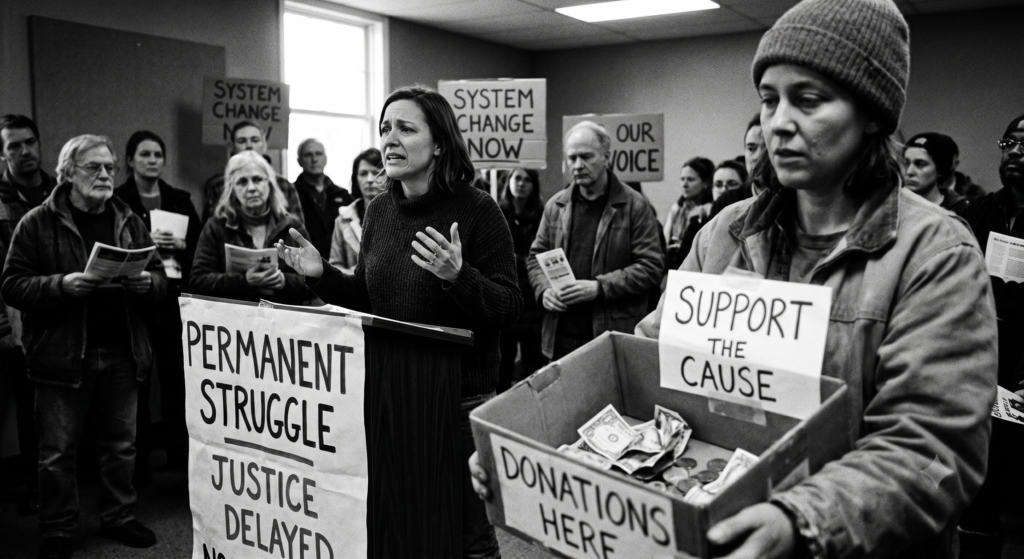
How grievance politics turns victimhood into a permanent political business model.
There is a particular cruelty embedded in the modern left’s most celebrated moral posture: the performance of compassion that never actually heals anyone. The left does not merely sympathise with the suffering; it requires it. Permanently. Structurally. Industrially. The moment a wound heals, the wound is no longer politically useful, and so the left has built an entire civilisational architecture dedicated to keeping wounds open, re-salting them on schedule, and then charging admission to the outrage spectacle. This is not an accident of ideology. It is the business model.
To understand how this works, you must first understand what Yuri Bezmenov, the KGB defector who escaped Soviet propaganda operations in 1970, identified as the machinery of demoralisation. Bezmenov explained that the primary tool of ideological subversion is not the bomb or the spy, but the slow, patient corruption of a society’s ability to perceive reality accurately. The method is to flood civil life with grievances so thick that no citizen can distinguish manufactured crisis from genuine injustice. Once the emotional circuits are overloaded, critical thinking collapses and people surrender to the comfort of a collective identity built entirely around shared injury. The left did not invent this tactic. But it has perfected it as a peacetime domestic political strategy.
The Architecture of Permanent Injury
The first structural requirement of grievance politics is that the grievance must never be resolved. Resolution is economic death. An advocacy organisation that eliminates its cause of existence must fire its staff, return its grants, and dissolve. No bureaucracy in human history has voluntarily done this. The left has therefore designed a class of political problems that are, by definitional construction, perpetually unsolvable.
Consider how this works in practice. The DEI (diversity, equity, and inclusion) industrial complex exploded after 2020. Federal DEI contracts in the United States went from $27 million in 2019 to over $1 billion annually by 2023, with single contract vehicles worth up to $7.5 million awarded to private consulting groups for “DEIA professional support services”. These were not one-time interventions. They were rolling contracts, structured to extend indefinitely, because the premise of the work is that racism, bias, and inequity are permanent features of institutional life requiring permanent remediation. The moment any institution declares itself sufficiently diverse, the contract ends. So no institution ever does. The industry’s survival depends on the permanence of the problem it claims to solve.
This is what the IRSA has documented as “the grievance industry”: an economic sector whose revenue depends directly on the intensity of grievances, encompassing media, political organisations, consultants, and service providers whose income structure requires that outrage never subside. It is not a conspiracy. It is an incentive structure, and incentive structures do not require coordination, only alignment of interest.
Victimhood as Political Currency
What the left engineered over the late twentieth century was the transformation of victim status from a temporary moral recognition into a durable, tradeable political currency. Tami Amanda Jacoby’s political theory of victimhood draws the crucial distinction between victimisation as an act of harm and victimhood as a collective identity built upon that harm. The left is not interested in victimisation, which is episodic and remediable. It is invested in victimhood, which is permanent and constitutive of group identity.
As researchers at Warwick Economics have described, “political entrepreneurs discover identity and policy memes, narratives, cues, and framing, that shift beliefs about how the world works or a person’s belief of who he is”. The critical word is “entrepreneur.” The architect of grievance politics is not a social worker or a therapist. He is a political entrepreneur with a product to sell, a constituency to maintain, and a revenue stream to protect. His product is the identity of the aggrieved. His constituency is the population who can be convinced that their suffering is systemic, irreversible, and attributable to an identifiable enemy class. His revenue, whether measured in votes, grants, donation dollars, or media attention, flows so long as the aggrieved believe their injury is both total and unsolvable by their own individual agency.
The mechanism as the viewfromcullingworth analysis made clear is that victim groups develop well-funded campaigning organisations, wealthy figureheads, and institutional leadership structures that then “shape laws and institutions in the interests of their particular group” in exchange for political support. This is not advocacy. It is a clientelism economy, where political parties purchase bloc votes with the promise of perpetual recognition of grievance, and victim-group leadership purchases institutional influence with the delivery of those blocs. Neither party in this transaction has any interest in the actual condition improving. Improvement would dissolve the bloc. Dissolution ends the exchange.
The Compassion Bureaucracy and Its Incentives
One of the most remarkable features of this system is the degree to which it mirrors the nomenkatura model that Milovan Djilas identified in communist Yugoslavia, what he called “the new class,” a bureaucratic elite that monopolises administrative control and consigns itself to a special privileged position while formally serving the collective. The DEI bureaucrat, the professional activist, and the diversity officer are not simply ideological warriors. They are, structurally, a new class: administrators of grievance whose livelihoods depend on the managed, non-resolution of the inequalities they are employed to address.
The parallel with the communist nomenklatura is not metaphorical; it is structural. In the Soviet system, as Bezmenov documented, “useful idiots” who genuinely believed in the revolution were, by ideological design, scheduled for elimination once they served their destabilisation function. In the contemporary Western grievance economy, the equivalent is slightly more subtle: the genuine advocates who actually reduce suffering lose their institutional power, because reduced suffering means reduced funding. The professional activist who delivers measurable improvement is, perversely, disadvantaging herself against the activist who delivers compelling narratives of ongoing crisis. The system selects for performance of victimhood over its alleviation.
City Journal’s investigation of the DEI complex confirmed this logic with precision: the federal government and private contractors “went all in on DEI” after 2020, but after years of billion-dollar spending, measurable outcomes on the metrics the industry claims to address, racial wealth gaps, representation, systemic bias reduction, showed no statistically significant improvement. The industry had successfully delivered more bureaucracy, more consultants, more training seminars, and more rolling contracts. It had not delivered equity. But equity was never the product. The product was the management of the claim of inequity.
Whittaker Chambers and the Architecture of Grievance
Whittaker Chambers, who spent years as a Soviet underground operative before his famous defection and testimony in the Hiss Case, recorded something essential in his memoir about how communist organisers understood the relationship between genuine suffering and political exploitation. Chambers described reading letters from unemployed, sick workers who sent donations to the Daily Worker because it had “given them something they found nowhere else: hope”. The party did not want to resolve these workers’ conditions. It wanted to maintain those conditions as the fuel for revolutionary energy. Lenin had emphasised worker correspondence not as a tool for actually helping workers but as an “arterial flow” of grievance that could feed the party.
This is the core logic of the compassion scam across its historical iterations. Hannah Arendt noted in her study of totalitarianism that both fascism and communism required identified “objective enemies” whose existence was necessary to justify the system’s permanent emergency status. The same logic operates in softer form in modern identity politics. There must always be an oppressor class, always be a systemic injustice, always be a crisis requiring the apparatus of the left to manage. Without the permanent enemy, the permanent victim has no function. Without the permanent victim, the permanent apparatus has no purpose.
The NPC Script: How Demoralization Works in Practice
Bezmenov’s four-stage model of ideological subversion, demoralization, destabilisation, crisis, and normalisation, maps onto the grievance economy with uncomfortable precision. Demoralization, the stage he said was already “basically completed” in the United States by the 1980s, involves training an entire generation to process reality through a framework of grievance rather than agency. A demoralised person, Bezmenov explained, “is unable to assess true information. The facts tell him nothing. Even if you shower him with authentic proof, with documents, with pictures, you still cannot change the basic perception and logic of behavior”.
This is the psychological mechanism that makes the victimhood business model self-reinforcing. Once a population has been trained to perceive all institutional outcomes as products of systemic bias, no evidence of individual agency, merit, or responsibility can penetrate the framework. The person who escapes poverty through effort is immediately reframed as “one of the lucky ones,” the exception that proves the oppressive rule. The institution that diversifies its leadership is immediately subjected to scrutiny for inadequate representation in some other dimension. The goalpost does not move randomly. It moves systematically, because the goalpost must always remain out of reach. The perpetual gap between current reality and the utopian benchmark is the product being sold.
The Business Model in Summary
What the modern left has constructed is not a politics of compassion. It is a politics that wears compassion as its customer-acquisition strategy and delivers permanent, managed suffering as its product. The structure is clear:
- Identify a genuine injustice and frame it as systemic, permanent, and attributable to an enemy class.
- Build institutional infrastructure, NGOs, academic departments, media networks, government offices, around the management of the grievance.
- Ensure that the metric of success is always process, never outcome: more programs, more training, more representation in the bureaucracy of grievance, never reduction in measurable suffering.
- Eliminate individual agency as a legitimate variable, because individual agency is the primary exit ramp from the victimhood economy. A person who believes she can improve her own condition stops being a reliable constituent.
- Perpetually expand the definition of victimhood to capture new demographics, new grievances, new revenue streams. The victimhood economy, like all economies, requires growth.
As the victimhood economy analysis from the Guardian observed, “identity-based grievances can be commodified, outrage is monetised, and a perpetual narrative of oppression is strategically used for personal, professional, or political gain”. The key word is “perpetual.” The scam is not that leftists are faking compassion in all cases. Many genuinely feel it. The scam is structural: the system they have built cannot reward genuine solutions, only genuine performances of crisis. Just as the communist party selected for operators who maintained rather than resolved proletarian suffering, the modern grievance economy selects for activists, academics, and politicians who are most skilled at narrating injustice, not alleviating it.
The Exit From the Machine
The compassion scam endures because it has successfully made criticism of the structure appear equivalent to denial of the original injustice. To question the DEI industry’s efficacy is to be labelled a racist. To note that professional activism has a financial interest in perpetual crisis is to “dismiss the lived experience of victims.” This is not a coincidence. It is the system’s immune response. Every viable political business model must make its own auditing impossible.
The real compassion, the kind that does not pay consultants or maintain bureaucracies or deliver rolling federal contracts, is the kind that tries to make itself unnecessary. The left used to understand this. Somewhere between the labour movements of the early twentieth century, which fought for specific measurable outcomes and won them, and the identity politics industry of the early twenty-first century, the left swapped a politics of liberation for a politics of permanent managed suffering. One delivered results and dissolved itself into history. The other builds palaces of institutional power on the backs of people it needs to remain broken. The tragedy is not that there are no real victims. The tragedy is that their suffering has been turned into somebody else’s career.