
Executive Summary
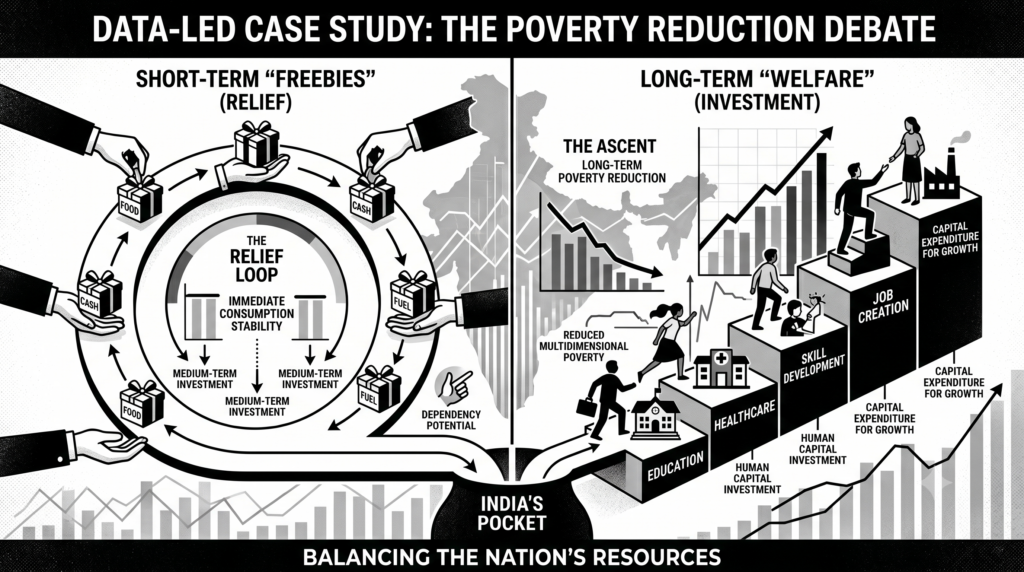
Indian welfare “freebies” reduce immediate hardship by lowering out-of-pocket spending on essentials such as food, electricity, transport, and cooking fuel, but the evidence that they create durable upward mobility is weak and often negative when fiscal and growth effects are included. Many schemes improve certain dimensions of the Multidimensional Poverty Index (MPI), notably sanitation, housing, electricity, and cooking fuel, but there is far less progress in education and health outcomes, which are the real drivers of long-term poverty reduction. Growing state-level spending on unconditional, consumption-oriented freebies is crowding out capital expenditure on infrastructure, schooling, and health, while worsening fiscal deficits and public debt, particularly in states like Punjab, Andhra Pradesh, and West Bengal.
The Economic Survey 2025-26 and multiple academic and policy studies warn that large-scale, recurrent freebies are generating structural fiscal liabilities without commensurate gains in productivity, human capital, or sustained income growth. Programs tightly linked to human capital, such as well-designed conditional cash transfers in Brazil’s Bolsa Família, show that welfare can reduce poverty durably if it is targeted, time-bound, and outcome-linked, but most Indian freebies do not meet these criteria. In short, freebies can prevent destitution and temporarily mask poverty, but by diverting scarce public resources away from growth-enhancing investment, they risk entrenching low productivity, weak job creation, and long-run fiscal fragility.
Conceptual Framework: Freebies versus Welfare
A clear distinction is necessary between genuine welfare programs and electoral freebies, because lumping them together blurs analysis. The Reserve Bank of India (RBI) and multiple policy briefs define freebies as goods or services given free of charge, often universally, with weak targeting and little link to long-term productivity, whereas welfare schemes are structured interventions designed to build capabilities, such as health, education, and social insurance. In the RBI’s classification, “non-merit” subsidies that do not generate lasting economic benefits or positive externalities are typically labeled freebies.
Freebies commonly include free electricity beyond lifeline consumption, universal loan waivers, free consumer durables like televisions or mixers, and unconditional cash doles not tied to schooling, health, or work. Welfare, by contrast, includes targeted public distribution of food grains under the National Food Security Act, health insurance for the poor, or scholarships and skill development subsidies that enhance human capital. This conceptual split matters because the empirical record shows that capability-building welfare can reduce long-term poverty, whereas indiscriminate freebies mainly shift consumption patterns in the short term while undermining the fiscal capacity needed for real development.
India’s Poverty Trends and the Role of Subsidies
Recent research by the World Bank and the International Monetary Fund (IMF) indicates that extreme poverty in India, defined at the international threshold of 1.90 PPP dollars per capita per day, has declined sharply over the last decade. One IMF paper that explicitly accounts for large food grain subsidies under the National Food Security Act and emergency support through PM Garib Kalyan Anna Yojana (PMGKAY) during the pandemic suggests that extreme poverty was around 0.77 percent in 2019 and 0.86 percent in 2020. When the poverty line is raised to 3.2 PPP dollars, however, the IMF estimates poverty at 14.8 percent of the population in 2019, while the World Bank puts it much higher, at 44.9 percent, indicating significant vulnerability just above the extreme poverty line.
This divergence underscores two points. First, large, in-kind food subsidies and emergency transfers have indeed kept millions from falling into extreme poverty, acting as a floor against destitution. Second, a substantial share of the population still lives close to the poverty line and remains vulnerable to shocks, which means that any welfare architecture must move beyond merely preventing starvation and aim to build income, skills, and resilience. In that context, it becomes crucial to ask whether the growing universe of freebies is helping people climb out of poverty or simply keeping them afloat while the state’s ability to invest in growth is eroded.
Multidimensional Poverty: What Improved, What Did Not
NITI Aayog’s updates to India’s Multidimensional Poverty Index show notable gains in several material deprivation indicators over the period from 2015-16 to 2019-20, particularly in sanitation, housing, electricity, and access to cooking fuel. The sharpest improvement, a reduction of around 21.8 percentage points in deprivation, was recorded in sanitation, largely driven by the Swachh Bharat Mission’s push to build toilets and eliminate open defecation. Deprivation in access to clean cooking fuel also fell significantly, as schemes like Pradhan Mantri Ujjwala Yojana expanded LPG connections.
However, the same MPI data reveal distressingly limited progress in education and health indicators over the same period. These dimensions, which directly shape earning capacity and productivity across generations, lag far behind the gains seen in infrastructure-like amenities that can be quickly improved via subsidy-driven schemes. Analysts argue that this pattern reflects a policy bias towards visible, easily deliverable “freebies” that show up quickly in MPI scores while leaving the deeper drivers of long-term poverty, such as quality schooling, nutrition, and primary healthcare, relatively underfunded and unreformed.
What the Data Say about Freebies and Consumption
Empirical analysis of subsidy-heavy schemes suggests that freebies are effective at lowering immediate consumption expenditure rather than lifting incomes. Commentators using NITI Aayog’s MPI updates argue that India is effectively fighting poverty by helping people spend less on essential goods and services, instead of raising their earning capacity. For example, free or heavily subsidized electricity, water, transport, and cooking fuel reduce the monthly cash outflows of poor households, which gives them some breathing space but does not structurally change their position in the labor market.
An article analyzing the “freebie economy” points out that these subsidies are politically sticky and hard to withdraw once granted, because beneficiaries come to regard them as entitlements. As a result, subsidy expenditure tends to rise over time, even as governments struggle with limited fiscal space to invest in human capital or productivity-enhancing infrastructure. The outcome is that poverty is cosmetically reduced in terms of current consumption deprivation but not in terms of sustainable income gains and reduced vulnerability.
Fiscal Cost of Freebies: State-Level Evidence
State budgets are where the costs of freebies are most visible. Recent analyses suggest that in 2023-24, the top eleven Indian states spent about ₹4 lakh crore on social welfare programs, including direct transfers, subsidized goods, and incentives, which together amounted to roughly 1.7 percent of their combined gross state domestic products (GSDPs). Expenditure on freebies varies widely, ranging from 0.1 percent to 2.7 percent of GSDP across states, with less-developed states often spending more relative to their GSDP despite weaker revenue bases. In Punjab, freebies have reportedly consumed about 45.4 percent of the state’s own tax revenue, and over 25 percent in states such as Andhra Pradesh, Jharkhand, Madhya Pradesh, and West Bengal.
The rising burden of freebies is contributing to high and often unsustainable state debt ratios. Projections indicate that by 2026-27, Punjab’s debt could exceed 45 percent of its GSDP, with Rajasthan around 39.4 percent, Kerala 38.2 percent, and West Bengal about 37 percent. Maharashtra’s “Ladki Bahin” scheme alone is budgeted at around ₹46,000 crore annually, close to 1.1 percent of the state’s GSDP, which, according to some analyses, is more than its entire agriculture budget in certain years. These numbers confirm that large, recurrent freebies are not marginal items but significant commitments that reshape state fiscal priorities.
Crowding Out Investment in Growth and Human Capital
A recurring theme in the literature is that high spending on freebies crowds out productive public investment in infrastructure, education, and health, which are essential for long-term poverty reduction. The Economic Survey 2025-26 explicitly warns that unchecked freebie culture among state governments is draining public finances and leaving little room for capital expenditure on roads, power transmission, irrigation, and urban infrastructure. It argues that freebies have widened revenue deficits and turned what should have been temporary safety nets into permanent fiscal liabilities.
The RBI’s “State Finances” study notes that in states like Telangana, subsidy expenditure, especially for free power to the farm sector and expanded pension schemes, has risen sharply and risks constraining future investments in health and education. The study highlights that direct benefit transfers (DBTs) have become a structural component of budgets and warns that increased emphasis on cash handouts can squeeze demographically sensitive sectors if not backed by sufficient revenue growth. Academic work on freebies similarly finds a strong positive correlation between electoral freebie spending, higher fiscal deficits, and lower long-term growth rates, reinforcing the crowding-out hypothesis.
Supreme Court and Institutional Concerns
India’s Supreme Court has repeatedly expressed unease about the expansion of freebies in election manifestos and post-election budgets. In a case scrutinizing Tamil Nadu’s finances, a three-judge bench led by the Chief Justice questioned how states can justify large-scale free electricity and direct cash transfer schemes while running sizable deficits and accumulating sectoral revenue gaps, such as an estimated ₹50,000 crore shortfall in the state’s power sector. The Court insisted that subsidies be transparently reflected in budgets and warned that hiding revenue gaps undermines fiscal discipline and burdens future generations.
The hearings have fueled a wider public debate on whether current freebie practices align with the constitutional vision of a welfare state or primarily serve electoral politics. Legal and policy commentators argue that unchecked freebies distort voter incentives, divert attention from long-term reforms, and compromise intergenerational equity as future taxpayers must service the debt incurred to finance today’s giveaways. Proposals include creating an institutional mechanism to vet major freebie promises, integrating them into fiscal responsibility frameworks, and requiring pre-announced funding plans.
Distinguishing Productive Welfare from Populist Freebies
Policy analysts emphasize that not all welfare-oriented spending is harmful; the problem lies in unconditional, consumption-centric giveaways that lack clear development logic. As summarized by an RBI-linked definition, welfare schemes that generate lasting economic benefits or positive externalities, such as better health, higher literacy, or improved employability, are qualitatively different from non-merit freebies that simply shift current consumption without building capabilities. For example, targeted food subsidies, primary healthcare, and school scholarships are more defensible on efficiency and equity grounds than distributing free consumer durables or promising universal unlimited electricity.
Studies note that freebies can create dependency, weaken work incentives, and distort resource allocation when beneficiaries calibrate their behavior around continuing state transfers instead of labor market participation. Over time, this dependence can erode the social contract by making citizens view the state as a dispenser of goods rather than a provider of opportunities and public goods. The net effect is that while some immediate poverty indicators may improve, the underlying engines of upward mobility, such as private investment, entrepreneurship, and skill formation, may stall or slow.
Do Freebies Reduce Long-Term Poverty? Evidence and Limits
The core question is whether freebie-heavy welfare regimes produce durable reductions in poverty. Available evidence suggests that while freebies are effective at alleviating short-term hardship and preventing destitution, they deliver at best mixed results on long-term poverty reduction and may, under certain conditions, worsen prospects by undermining growth and fiscal stability. One empirical study on Indian freebies and subsidies concludes that although such measures can temporarily improve living standards and provide immediate relief, they often fail to tackle the structural drivers of poverty and introduce long-run inefficiencies that drag on economic performance.
Comparative evidence from conditional cash transfer programs, such as Brazil’s Bolsa Família, indicates that when welfare is tied to schooling, vaccination, and other human capital conditions, it can achieve more durable poverty reduction. The Economic Survey 2025-26 explicitly cites Bolsa Família as a model of outcome-linked, time-bound support, in contrast to India’s mostly unconditional, recurring cash and in-kind freebies that have not produced comparable gains in education or nutrition. This suggests that the problem is not public spending on the poor per se, but the design of schemes that prioritize political visibility over capability building.
Case Example: Ladli/Ladki Bahin and Female-focused Cash Schemes
Recent years have seen a proliferation of women-focused cash transfer schemes, such as Madhya Pradesh’s Ladli Behna and Maharashtra’s Ladki Bahin programs, which promise monthly income support to adult women. Studies assessing these schemes find that they do raise short-term consumption and provide some financial autonomy, but struggle to demonstrate sustained improvements in nutrition, labor force participation, or long-term poverty metrics. The Economic Survey argues that such schemes, though politically attractive, have not delivered durable gains in empowerment or human capital, while significantly deepening revenue deficits and crowding out capital expenditure.
The fiscal scale of these programs is substantial. Maharashtra’s Ladki Bahin scheme alone, with an annual budget of around ₹46,000 crore, is roughly 1.1 percent of the state’s GSDP and in some allocations exceeds the entire agriculture budget. Academic work on these schemes concludes that while they may register as successes in terms of immediate beneficiary satisfaction and electoral returns, their long-run impact is tilted towards fiscal stress and economic dependency instead of structural poverty reduction.
RBI and Policy Research: Macro Risks of Freebie Culture
The RBI’s analysis of state finances consistently flags the macroeconomic risks of escalating freebies. Its studies show that social security and welfare expenditure, driven significantly by expanded DBTs and subsidy commitments, has risen as a share of total spending in many states, especially aging ones like Kerala and Tamil Nadu, where it now accounts for around 18 percent. The RBI warns that if such expenditure continues to grow faster than revenue and crowds out capital investment, it will weaken the growth potential needed to fund any welfare state sustainably.
Policy research articles echo this caution. One journal paper examining the impact of freebies on economic growth and social development argues that heavy freebie spending is associated with increased borrowing pressures, reduced infrastructure investment, and higher beneficiary dependency. Another study focused on electoral freebies and public policy finds a strong positive correlation between freebie-driven welfare spending, higher fiscal deficits, and lower long-term growth rates, highlighting the potential for a low-growth, high-populism equilibrium. These findings reinforce the view that freebie culture can subtly undermine the very economic base required for genuine poverty reduction.
Political Economy: Why Freebies Persist
Despite their contested effectiveness on long-term poverty reduction, freebies remain central to India’s electoral politics. Analysts explain this persistence through political economy logic: freebies are visible, easily communicable, and generate identifiable beneficiaries, whereas long-horizon investments in education, health, or institutional reform produce diffuse and delayed benefits that are harder to convert into votes. This visibility bias encourages parties to compete in announcing ever more generous schemes, escalating a “race to the bottom” in fiscal responsibility.
Moreover, once a freebie is introduced, withdrawing or reforming it is politically risky because beneficiaries, even if they are not truly poor, may mobilize against any perceived loss. Courts and independent institutions have limited tools to constrain such competitive populism unless explicit legal frameworks or fiscal rules are established. The net effect is that democratic competition, in the absence of strong fiscal norms, tends to entrench and expand freebies even when their contribution to long-term poverty reduction is marginal.
International Comparisons: Welfare without Freebie Addiction
International experience shows that welfare can coexist with strong growth and sustainable finances when programs are well designed. Brazil’s Bolsa Família, often cited by Indian policymakers, combined cash transfers with conditions on school attendance, vaccinations, and health check-ups, and has been credited with reducing both poverty and inequality over time. Similarly, targeted welfare programs in countries like Mexico and Chile emphasize human capital formation and often include sunset clauses or periodic evaluation, limiting the risk of permanent fiscal entitlements divorced from development goals.
By contrast, models that rely on generalized subsidies and broad-based consumption freebies, such as untargeted fuel or electricity subsidies, have tended to create large fiscal burdens, encourage wasteful use, and leave structural poverty largely intact. The lessons for India are clear: welfare that is conditional, targeted, and tied to investments in human capital is more likely to produce durable poverty reduction than unconditional, universal freebies focused on current consumption.
Normative and Ethical Considerations
The debate over freebies is not purely economic; it also raises ethical questions about the nature of citizenship and the social contract. Critics argue that treating citizens primarily as recipients of gifts rather than as rights-bearing pa
rticipants in a productive economy encourages a culture of entitlement and weakens accountability, both of politicians and recipients. When electoral competition revolves around ever larger handouts, attention shifts away from structural reforms in governance, rule of law, and market functioning that are crucial for inclusive growth.
On the other hand, defenders of expansive welfare emphasize that India still has high levels of multidimensional poverty and inequality, and that the state has a moral duty to protect the vulnerable. The critical distinction, therefore, is not between “welfare” and “no welfare,” but between welfare designed as a bridge to self-reliance and welfare structured as permanent dependency. Data on India’s freebie-heavy schemes suggest that many are tilted toward the latter, with insufficient integration into pathways for employment, skill upgrading, or entrepreneurship.
Policy Directions: Designing Welfare that Builds Mobility
Evidence from India and abroad points to several design principles for welfare that reduces long-term poverty without falling into the freebie trap. First, schemes should be tightly targeted based on transparent criteria, such as income, deprivation, or vulnerability, rather than extended universally for vote-bank reasons. This reduces fiscal cost and ensures that resources reach those most in need. Second, linking support to human capital outcomes, through conditionalities on schooling, healthcare, or skill training, helps convert short-term relief into long-term capability gains.
Third, welfare programs should have sunset clauses, regular evaluations, and clear outcome metrics, so that ineffective or fiscally unsustainable schemes can be scaled back or redesigned. Fourth, fiscal rules could limit the share of state revenue or GSDP that can be spent on non-merit freebies, protecting space for capital expenditure and core public goods. Finally, strengthening state capacity in areas like tax administration, social registry management, and program monitoring is essential to shift from populist distribution to evidence-based welfare policy.
Conclusion
The weight of available data and research indicates that India’s current model of freebie-driven welfare provides short-term consumption relief but is poorly equipped to deliver durable reductions in poverty. Extreme poverty has declined, partly thanks to large food subsidies and emergency support, but broader vulnerability remains high and progress in education and health has been modest. At the same time, state finances are increasingly strained by recurrent freebies that consume substantial shares of own-tax revenue and crowd out investment in infrastructure and human capital, especially in fiscally weaker states.
In this configuration, freebies risk becoming a narcotic: they keep political discontent in check and mask some symptoms of poverty, but gradually weaken the economic and fiscal foundations required for real upward mobility. The empirical and comparative evidence suggests that India needs to pivot from universal freebies to targeted, outcome-linked welfare that builds capabilities and is embedded within a framework of fiscal responsibility. Without such a shift, extensive welfare freebies are less likely to “end” poverty and more likely to lock the country into a low-growth, high-debt equilibrium where genuine mobility remains elusive.