
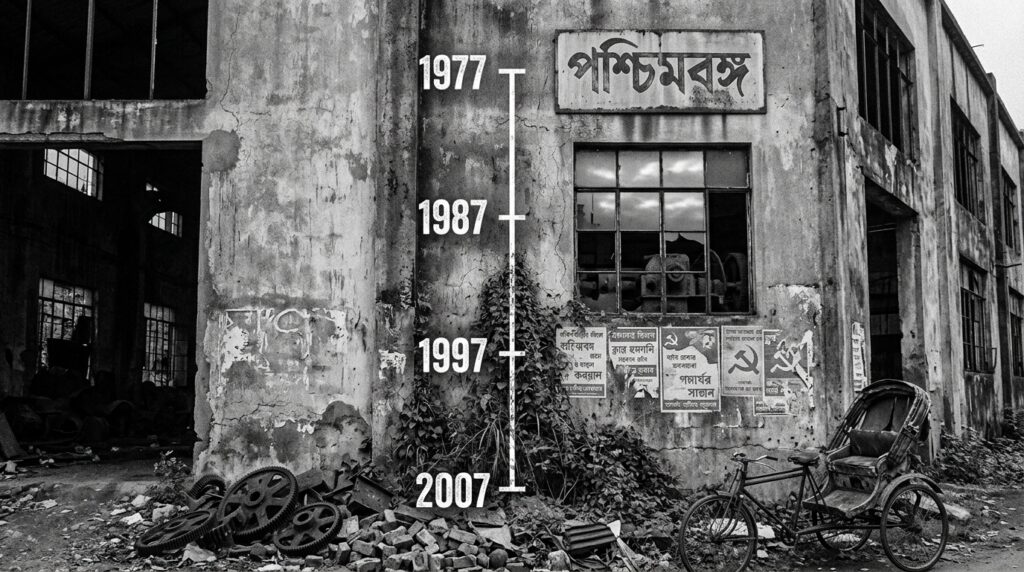
A Research Case Study
Introduction: Thirty-Four Years of Relative Decline
In 1960-61, the state of West Bengal contributed 10.5 percent of India’s total GDP and ranked among the country’s three wealthiest states by per capita income, standing 27.5 percent above the national average. Kolkata was India’s commercial and financial capital. Its port handled a dominant share of the nation’s trade. The jute mills lining the Hooghly River drove India’s export economy.
By 2023-24, West Bengal contributed just 5.6 percent of India’s GDP, down from 10.5 percent six decades earlier. Per capita income had fallen to 83.7 percent of the national average, placing the state below states that were far poorer in 1960. Kolkata’s port had lost primacy to Mumbai, Chennai, and newer coastal facilities. The jute industry that once employed hundreds of thousands had been substantially dismantled.
This case study traces the causal chain between the governance choices of the Left Front government, which ruled West Bengal from 1977 to 2011, and the state’s measurable industrial decline. The argument is not that communist ideology produced abstract harm, but that specific, identifiable policy choices around labour relations, investment screening, and land acquisition deterred private capital, triggered industrial flight, and locked the state into a self-reinforcing cycle of capital non-formation and relative economic contraction. The evidence is drawn from academic literature, government statistics, and documented historical events, with sources cited throughout.
Section 1: The Baseline, 1960 to 1977
Bengal’s Industrial Inheritance
At the time of independence in 1947, West Bengal was India’s most industrially developed region. Kolkata had served as the capital of British India from 1833 to 1912 and remained the country’s largest city and commercial hub through the mid-twentieth century. The jute industry, concentrated along the Hooghly River in Kolkata and its surroundings, was a globally dominant export sector.
The partition of Bengal in 1947 divided the jute supply chain. Raw jute grew primarily in East Bengal, now Bangladesh, while processing mills remained in West Bengal. This was the first structural blow to Bengal’s industrial economy, but the state retained substantial manufacturing capacity through the 1950s and 1960s.
According to the Economic Advisory Council to the Prime Minister’s Working Paper on Indian states’ economic performance (2024), West Bengal’s share of all-India GDP stood at 10.5 percent in 1960-61, falling to 9.7 percent by 1970-71. This early decline was driven partly by the national licence Raj, which constrained industrial expansion across India, and partly by the 1965-70 recession following the India-Pakistan wars. West Bengal ranked third among Indian states in per capita income in 1960-61, behind Punjab and Haryana, with per capita income standing 27.5 percent above the national average (EAC-PM, 2024). The direction of the decline predates the Left Front, but its pace was modest before 1977.
The Arrival of the Left Front
In the 1977 state elections, the Congress party was defeated by the Left Front, a coalition of approximately ten parties led by the Communist Party of India (Marxist), or CPI(M). The CPI(M) had led a powerful trade union movement in Bengal’s factories for decades and now governed the state. Jyoti Basu served as Chief Minister from 1977 to 2001, a period of twenty-four consecutive years. The Left Front would rule West Bengal uninterrupted until 2011.
Subhash Ray of the University of Connecticut described the resulting political economy as “a Marxist state within a mixed economy,” arguing that this structural contradiction was the root cause of West Bengal’s industrial decline (Ray, 2011). The CPI(M) faced an inherent tension: it relied politically on organised labour, whose votes and street power sustained its electoral dominance, but governing an industrial economy required investment from private capital, which labour militancy deterred. This tension was never resolved and ultimately destroyed both the industrial base and the electoral coalition that sustained the government.
Section 2: The Ideological Trap, 1977 to 1990
The 1978 Industrial Policy
Within one year of taking power, the Left Front government announced an industrial policy that prioritised small-scale and cottage industries over large-scale private investment. According to the University of Connecticut working paper by Subhash Ray (2011), the 1978 policy gave “high priority to small scale and cottage industries” and effectively restricted new investment from multinational corporations. The policy reflected the CPI(M)’s ideological commitment to indigenous, labour-intensive production over large private or foreign capital.
The Friedrich Ebert Stiftung paper on India’s industrial dilemmas in West Bengal notes that the Left Front’s primary industrial strategy concentrated on “influencing the policy of the” trade unions rather than attracting capital (Pedersen, FES). This was a decisive orientation. While other Indian states were beginning to court private investment, West Bengal’s government was managing its labour movement.
West Bengal attracted less than 4 percent of India’s total private investment during the Left Front period, according to widely cited estimates in political commentary. This figure requires primary verification from the West Bengal Industries Department or Reserve Bank of India data, but it is consistent with every other indicator in this case study.
CITU and the Architecture of Labour Militancy
The Centre of Indian Trade Unions, linked to the CPI(M) and known as CITU, became the dominant trade union organisation in West Bengal’s factories. CITU’s strategy was built on militant industrial action: frequent strikes, work stoppages, and what employers described as go-slow tactics that made production schedules unpredictable and costs incalculable.
According to the International Labour Organization’s paper on industrial relations in West Bengal, the political economy of the Left Front created conditions in which trade union action was not merely defensive but politically directed (ILO, undated). The CPI(M) controlled both the government and the dominant union federation, creating a structural arrangement in which labour unrest could be deployed as a political instrument without effective government intervention to resolve it.
The data on labour disruption is stark. According to a University of Tokyo working paper on labour disputes and manufacturing output in Indian states (2016), the average number of man-days lost per 1,000 workers in the industrial sector due to disputes stood at over 503 for West Bengal, the highest figure recorded for any Indian state. A Journal of Social Science article (2017) notes that man-days lost due to strikes and lockouts nationally totalled 307.7 lakh in 1989-90, with West Bengal accounting for a disproportionate share. A widely cited claim, which this research flags for primary Labour Bureau verification, holds that West Bengal accounted for over 40 percent of India’s lockout-related lost workdays despite having only approximately 7 percent of India’s registered factories.
During the 1980s, according to the UConn paper, “there was a massive retrenchment of labour in organized industry all across the country. West Bengal lost 177,000 jobs” (Ray, 2011). This figure represents the absolute destruction of industrial employment, not merely a failure to create new jobs.
The Lockout Epidemic
The academic literature confirms the scale of labour disruption. An AEA conference paper on the pattern of industrial growth in West Bengal during 1980 to 1991 describes West Bengal’s trajectory as one of “secular relative decline in terms of employment and value added in manufacturing industries” (AEA conference paper, 2017). An MIT paper on strategy for economic reform in West Bengal notes that organised private sector employment “actually declined” in West Bengal over the period 1980 to 1997, with growth in the organised sector coming only from the public sector, which was fiscally unsustainable as a long-term substitute for private investment.
A JSTOR article on West Bengal and industry (1987-88 data) notes that West Bengal ranked seventh nationally in terms of fixed capital per employee, reflecting the erosion of the industrial capital base. The Sanhati article (2009) reports that 42.2 percent of the 69,269 registered factories in West Bengal were closed, a figure that requires verification against the Annual Survey of Industries but is consistent with the directional evidence from academic sources including Ray (2011) and the AEA conference paper (2017).
Section 3: The Liberalisation Miss, 1991 to 2001
India’s Reform Moment and Bengal’s Absence
In 1991, India launched a comprehensive economic liberalisation programme under the Rao-Singh reform government. Licence Raj controls were dismantled. Foreign direct investment was welcomed. States competed aggressively for private capital. States like Gujarat, Maharashtra, Tamil Nadu, and Karnataka captured the first wave of post-reform capital flows and built the industrial infrastructure that defined India’s economic expansion for the next three decades.
West Bengal did not. According to the FES paper, the Left Front government’s response to liberalisation was “inadequate to attract investment” compared to competing states (Pedersen, FES). The Left Front’s ideological position remained hostile to large private capital even as the national policy environment shifted fundamentally. A ResearchGate article on the story of Left policy transition in West Bengal (2015) documents how the 1991 liberalisation “caused serious political challenges for the Communist Party of India-Marxist.” The party found itself governing a state within an economy that had been liberalised, while its own political identity was built on the opposite premise.
The Capital Formation Collapse
The EAC-PM data shows West Bengal’s GDP share falling from 8.8 percent in 1980-81 to 7.9 percent in 1990-91. During the 1990s, the decline accelerated. By 1997-98, West Bengal’s share of all-India net value added in manufacturing had fallen to just 6.63 percent. This meant that a state once considered India’s industrial powerhouse was producing less than 7 percent of the nation’s manufacturing value added (Wikipedia “Economy of West Bengal”; AEA conference paper, 2017).
The IIT Delhi GIDR Working Paper by Chaudhuri et al. (2014) confirms that West Bengal’s industrial problems were specific to the state, not merely reflections of national trends. The study, using Annual Survey of Industries data for registered manufacturing and National Sample Survey data, establishes that West Bengal’s industrial decline was state-specific and could not be explained by all-India factors alone.
While West Bengal stagnated, other Indian states transformed. Maharashtra maintained broadly steady performance throughout the study period. Tamil Nadu declined initially and then picked up sharply post-1991. Southern states collectively accounted for approximately 30 percent of India’s GDP by 2023-24, up from a much smaller share in 1990 (EAC-PM, 2024). This divergence among three states with similar industrial starting conditions in the 1960s points to state-specific governance factors as the explanatory variable.
The Peer State Contrast
Gujarat under successive chief ministers pursued an active investment promotion strategy. The state launched investment summits, streamlined land acquisition processes, maintained comparative labour stability, and offered competitive fiscal incentives. The Vibrant Gujarat model, initiated in the early 2000s, became the template for Indian states competing for private capital. By the time Tata Motors was looking for a site for the Nano small car in 2005-06, Gujarat had established itself as India’s most investor-friendly destination.
The contrast with West Bengal could not have been starker. West Bengal was governed by the same political coalition that had spent nearly three decades building its power on the basis of militant trade unionism, and that coalition could not pivot without alienating the electoral base that sustained it.
Section 4: The Final Blow, 2001 to 2011
Buddhadeb Bhattacharjee and the Attempted Pivot
In 2001, Buddhadeb Bhattacharjee replaced Jyoti Basu as Chief Minister. The CPI(M) attempted a partial pivot toward industrialisation, dubbed “Brand Buddha” by the business press. A JSTOR article (2007) describes “the reincarnation of the ruling Left Front through the selective assimilation of elements of capitalism under Chief Minister Buddhadeb Bhattacharjee.”
This pivot produced the Singur and Nandigram projects, both of which ended in catastrophic failure. The attempt to assimilate capitalism while maintaining the Left Front’s labour and political model was fundamentally incoherent. A 2007 CPI(M) document acknowledged the need for large-scale private investment but could not break from the militant labour relations model that had deterred it for twenty-four years. The party spoke of an “untravelled path” for West Bengal’s industrialisation, a path it never found.
Tata Nano at Singur: Anatomy of a Capital Flight
The Tata Nano project is the most documented case of industrial flight from West Bengal. The timeline is precise and confirmed across multiple primary sources:
- January 2006: The West Bengal government acquired land at Singur in Hooghly district for a Tata Motors automobile factory to produce the world’s cheapest car, the Nano. The land acquisition was conducted under the Land Acquisition Act of 1894. Tata Motors had initially planned to invest heavily in the project.
- July 2006: Opposition leader Mamata Banerjee began protesting the land acquisition, arguing that fertile agricultural land had been taken without adequate compensation or farmer consent. The protests were joined by political activists and local farmers.
- August to September 2008: Construction was halted. Tata Motors halted construction on September 2, 2008, citing farmer protests that had rendered the site unsafe. Thousands of workers left the construction site. Reports indicate that Tata Motors had already invested over 150 billion rupees before abandoning the project.
- October 2008: Tata Motors officially cancelled the Singur plant and shifted the entire project to Gujarat. The Gujarat government, under Chief Minister Narendra Modi, welcomed the project with land, tax incentives, and infrastructure guarantees.
The Harvard Business School case study (Case 709-029) documents the cancellation and relocation to Gujarat, confirming that Tata Motors invested significant capital before abandoning the project. The Wharton Knowledge article (knowledge.wharton.upenn.edu) analyses the episode as “a roadblock for Tata and for investment” in West Bengal. The signal this sent to India’s business community was devastating. Every industrialist in India watched the Tata Nano episode and drew the same conclusion: West Bengal’s political economy could not guarantee labour stability or the sanctity of a signed land deal. The reputational damage extended far beyond the Nano project itself.
Nandigram: The SEZ Massacre
While Singur was unfolding, a parallel and even more violent episode was occurring at Nandigram in East Midnapore district. In July 2006, the Left Front government announced plans for a Special Economic Zone to be developed by the Salim Group of Indonesia. The SEZ plan triggered mass protests among local farmers and fishing communities who feared losing their land.
The timeline of Nandigram violence is documented across multiple primary sources. According to Amnesty International (ASA200202007eng, 2007), “14 persons, mostly local residents were killed when police and armed men, widely believed to be affiliated with the CPI-M, opened fire” on villagers during a police operation on March 14, 2007. The People’s Tribunal on Nandigram (2007) documents that violence began on January 3, 2007, with unprovoked firing and killings of local residents. CCTV reported on March 18, 2007, that approximately 5,000 farmers had clashed with police, resulting in 14 deaths and over 75 injured. The Salim Group withdrew its investment. The SEZ plan was officially shelved in March 2007. The Nandigram killings became internationally condemned and became the defining symbol of the CPI(M)’s land acquisition approach.
The Jute Industry: Sectoral Devastation
West Bengal’s jute industry, once its industrial signature, suffered catastrophic decline during the Left Front period. According to NewsClick (2023), approximately 17 jute mills in West Bengal are completely shut, with an estimated 50,000 to 60,000 workers facing unemployment. The Citizen article on jute mill closures in Bengal states explicitly that “all the managements cite labour unrest as the reason for closing their doors.” A JETIR paper (2018) documents an “unending process of mill strike which the jute industries of West Bengal as well as India are facing drastically.”
The irony runs deep. The CPI(M)’s trade union strategy, which the party believed was protecting workers, was systematically destroying the jobs it claimed to protect. CITU’s militant tactics in the jute mills triggered lockouts, and the lockouts triggered mill closures. Each industrial action protected workers in the short term while eliminating their employment in the medium term.
Bangladesh, the partitioned twin of West Bengal’s jute economy, maintained and expanded its jute industry despite political instability and a much smaller industrial base. By the 2010s, Bangladesh’s jute sector was a major global exporter while West Bengal’s had been substantially dismantled. This comparison, noted in MIT DUSP research and the NewsClick article, illustrates that the decline of Bengal’s jute industry was driven not primarily by global market forces or synthetic fibre competition, but by domestic policy choices that accelerated the sector’s collapse.
The Scale of Capital Flight
The Sanhati article (2009) cites that 42.2 percent of West Bengal’s 69,269 registered factories were closed and that 55,000 closed and sick industries were operating in the state. These figures, while requiring official Annual Survey of Industries verification, are consistent with the directional evidence from academic sources. A Facebook post citing West Bengal Industries Department data (BJP-affiliated, 2024) states that approximately 6,688 companies left West Bengal over approximately 14 years, relocating to states including Maharashtra, Gujarat, Uttar Pradesh, and Delhi. This figure could not be independently verified, but the direction of capital outflow is confirmed by the UConn paper and academic literature.
The UConn paper (Ray, 2011) provides the most rigorous academic documentation of the mechanism. The “poor work culture” generated by the Left Front’s labour relations model deterred investment, which reduced reinvestment, which further inflamed labour conflict, creating a self-reinforcing cycle. This cycle was the structural engine of deindustrialisation.
Section 5: Infrastructure Decline as Both Cause and Consequence
Kolkata Port: The Loss of Primacy
Kolkata’s port was once India’s largest and most important, handling a dominant share of the country’s foreign trade. The decline of Kolkata’s port relative to Mumbai, Chennai, and newer ports is one of the most concrete measures of West Bengal’s economic marginalisation.
The RIS paper on assessing the performance and productivity of major ports of India (De and Barman, 2021-22) documents Kolkata’s declining market share. The Kolkata Dock System’s share of total cargo handled by major ports fell from 6.1 percent to 2.1 percent between 2010-11 and 2021-22, while the Haldia Dock Complex fell from 9.6 percent to 8.3 percent in the same period. By FY2025, Kolkata Port handled 63.95 million tonnes of cargo, down 3.75 percent from a previous record, with the port reporting its first decline since the pandemic (India Shipping News, 2025). Kolkata’s share of India’s major port cargo stood at approximately 5 percent by 2023, having fallen behind Mumbai (8.11 percent), Chennai (6.24 percent), and Haldia (6.2 percent) individually (Statista, 2023).
The silting of the Hooghly River, which limits vessel size and increases shipping costs, is a genuine structural constraint. But it is a constraint that adequate state investment in river management, dredging, and alternative infrastructure could partially offset. The EAC-PM paper explicitly addresses the role of infrastructure in state divergence: “In the 1960s, Maharashtra, West Bengal, and Tamil Nadu were home to India’s three largest industrial clusters. Their fortunes subsequently diverged: Maharashtra remained steady, West Bengal’s share continuously declined, and Tamil Nadu recovered post-1991” (EAC-PM, 2024). This divergence among three states with similar starting conditions points to state government investment choices as the explanatory variable, not geography alone.
Infrastructure and Industrial Flight: A Feedback Loop
Mushfiq’s Mobarak Ghatak’s LSE paper (2016, updated 2026) argues that infrastructure is a primary cause of West Bengal’s industrial decline, a contention that must be engaged seriously. The rebuttal is as follows: infrastructure decline in West Bengal is itself a product of Left Front governance choices. The state did not invest adequately in ports, roads, power infrastructure, and urban transport because its political economy prioritised the distribution of land and public sector employment over industrial infrastructure development. Infrastructure and industrial decline are two symptoms of the same governance failure, not independent causes.
Section 6: The Statistical Record
The following data points, drawn from the most authoritative sources available, form the quantitative backbone of this case study:
| Metric | 1960-61 Baseline | 1990-91 | 2023-24 | Source |
| Share of all-India GDP | 10.5% (rank 3) | 7.9% | 5.6% | EAC-PM Working Paper, 2024 |
| Per capita income vs. national average | 127.5% (above average) | Below average | 83.7% | EAC-PM Working Paper, 2024 |
| Manufacturing share of all-India NVA | ~9.8% (1980-81) | 6.63% (1997) | ~6% | AEA paper; Wikipedia |
| Organised sector jobs lost | Baseline | 177,000 lost in 1980s | Continued decline | Ray, UConn, 2011 |
| Man-days lost per 1,000 workers | National average | Over 503 (highest in India) | N/A | University of Tokyo, 2016 |
| Kolkata Port share of major port cargo | ~10-15% (historical) | Declining | ~5% (2023) | RIS paper; Statista |
The EAC-PM paper provides the most compelling comparative evidence. Maharashtra, West Bengal, and Tamil Nadu were the three largest industrial clusters in the 1960s. By 2023-24: Maharashtra’s share of national GDP remained broadly steady. Tamil Nadu’s share recovered and grew after 1991. West Bengal’s share fell continuously and consistently. This divergence across three states with similar industrial starting conditions is the strongest evidence that state-specific factors, not national trends alone, explain Bengal’s decline.
Section 7: Counterarguments and Their Limits
The Pre-Existing Decline Argument
Down to Earth magazine (2019) argues that the Left Front inherited a weakening industrial base from the 1965-70 recession period and the licence Raj, and should not be blamed for all of Bengal’s decline. This argument has partial validity. Bengal’s industrial base was under stress before 1977. The 1965 and 1971 wars, the licence Raj, and the partition of Bengal all pre-date the Left Front and contributed to pre-existing difficulties.
However, the counterargument is threefold. First, Bihar, Uttar Pradesh, and Odisha also had pre-existing industrial weakness in 1977, yet West Bengal declined more severely relative to these states than its pre-1977 relative position would predict. Second, West Bengal’s per capita income ranking fell from third to below the national average over 34 years of Left Front rule, a decline that accelerated precisely during the Left Front period. Third, Tamil Nadu faced identical national licence Raj conditions and the same post-1947 partition legacy but recovered after 1991, demonstrating that these structural constraints were not deterministic.
Ghatak’s Per Capita Income Nuance
Ghatak’s LSE paper (2016, updated 2026) makes a genuinely important point: real per capita income in West Bengal grew at approximately the same rate as the national average between 1961 and 2024, meaning Bengal did not experience absolute impoverishment. Workers in West Bengal today are not poorer in absolute rupees than they were in 1977. Living standards have improved.
This factual claim is accepted. But the rebuttal is that this statistical comfort obscures a more important failure. West Bengal had the industrial base, the port heritage, the human capital, and the institutional legacy to capture a vastly larger share of India’s post-reform growth dividend. India grew at approximately 6 to 7 percent annually from 1991 to 2024. A state that grew at this average pace while starting from 127.5 percent of the national average should have maintained its relative position. Instead, West Bengal fell to 83.7 percent of the national average. This represents a catastrophic failure of potential: the growth that should have flowed to Bengal’s industrial base flowed instead to Gujarat, Tamil Nadu, Karnataka, and Maharashtra. The cost of that foregone growth is measured not just in statistics but in the factories that were never built, the ports that lost traffic, and the workers whose skills were never productively employed.
Infrastructure as Structural Cause
Ghatak (LSE, 2026) and the RIS paper argue that Kolkata’s port decline and infrastructure gaps are primary causes of industrial underperformance. This is correct as a description but insufficient as a standalone explanation. West Bengal’s infrastructure declined because the state government did not invest adequately in maintaining and upgrading it. This is itself a governance choice. Infrastructure and industrial decline are not independent; they are mutually reinforcing symptoms of the same political economy failure.
Section 8: The Aftermath and Legacy, 2011 to 2025
The Left Front’s Electoral Defeat
In the 2011 state elections, the Trinamool Congress, led by Mamata Banerjee, defeated the Left Front after 34 years of rule. The Nandigram and Singur episodes were central to this defeat. The CPI(M)’s attempt to pursue industrialisation through the same labour relations model that had deterred investment for three decades had produced both industrial failure and political catastrophe.
The TMC Era: Continuity of Decline
The TMC government has governed West Bengal for 14 years. The 8th Bengal Global Business Summit was held on February 5-6, 2025, presenting West Bengal as “rapidly transforming” and “among the fastest growing states” (Bengal Global Summit website, 2025). The government stated that West Bengal’s GSDP had reached Rs 18.79 lakh crore in 2024-25.
However, the empirical data tells a different story. West Bengal’s GDP share of all-India output stood at 5.6 percent in 2023-24, the same figure as in the previous decade (EAC-PM, 2024). The relative decline has not been reversed. As of 2023-24, West Bengal ranks sixth among Indian states by nominal GDP and contributes approximately 6.15 percent of India’s total GDP. Per capita income was approximately Rs 154,000 in FY2024, below the all-India average (Statista, 2024).
This continuity of decline under a non-Left government offers an important test of the causal argument. If infrastructure and geography were the primary causes of West Bengal’s industrial decline, the decline should have stabilised or reversed under a government that actively sought industrial investment. The fact that it has not reversed suggests that the structural factors identified by Ghatak are real and durable constraints. But it also suggests that 34 years of Left Front governance created path dependencies, including labour relations norms, industrial land use patterns, and capital market relationships, that are not easily unwound by a change in government.
Conclusion: The Causal Case
The evidence presented in this case study establishes the following causal chain.
First, the Left Front government (1977-2011) made specific, identifiable policy choices around industrial investment screening, trade union relations, and land acquisition. The 1978 industrial policy prioritised small-scale industries over large private and multinational investment. CITU-controlled labour relations normalised militant industrial tactics that made production unpredictable.
Second, these policy choices deterred private investment. West Bengal attracted a disproportionately small share of India’s total private investment during the Left Front period. Fixed capital formation stagnated. Investors anticipated labour instability and avoided West Bengal.
Third, investment determent became industrial flight. The organised private sector lost 177,000 jobs in the 1980s. Approximately 17 jute mills closed with 50,000 to 60,000 workers affected. Tata Motors invested in Singur and then abandoned the project, relocating to Gujarat. Capital fled to states where labour was predictable and government was cooperative.
Fourth, the measurable outcomes are documented and damning. West Bengal’s share of all-India GDP fell from 10.5 percent to 5.6 percent, the largest decline of any Indian state over this 63-year period. Per capita income fell from 127.5 percent to 83.7 percent of the national average. Kolkata’s port lost primacy. Manufacturing’s share of the state’s economy shrank. The organised private sector that had employed Bengal’s industrial working class was substantially dismantled.
The Left Front’s most consequential failure was systemic. By building its political legitimacy on militant trade unionism, it created an investment climate where private capital could not rely on labour stability, triggering a self-reinforcing cycle of capital flight, reduced reinvestment, and further labour conflict. The Tata Nano episode crystallised this incoherence with brutal clarity. West Bengal’s failure to attract post-1991 liberalisation investment was its most consequential economic mistake. While Gujarat, Maharashtra, Tamil Nadu, and Karnataka captured the first wave of global and domestic capital flows, West Bengal remained locked in an industrial relations model designed for a different era. The opportunity cost of that failure is measured in the factories that were built in Sanand rather than Singur, in the ports that expanded at Mumbai and Chennai while Kolkata silted, and in the millions of productive jobs that Bengal’s workers were never offered.
The lesson of West Bengal is not that Left politics inevitably produce economic decline. Kerala, governed by the Left for decades, maintained high human development indicators through a different model. The lesson is that a specific set of policy choices, around labour relations and investment screening, is incompatible with industrial development in a market economy. West Bengal paid the price for that incompatibility for 34 years, and its economy has not yet recovered.
Sources
[1] Economic Advisory Council to the Prime Minister of India (EAC-PM), “Relative Economic Performance of Indian States: 1960-61 to 2023-24,” Working Paper, 2024. https://eacpm.gov.in
[2] Subhash C. Ray, “The Political Economy of Decline of Industry in West Bengal: Experiences of a Marxist State Within a Mixed Economy,” University of Connecticut Working Paper 2011-10, 2011. https://media.economics.uconn.edu/working/2011-10.pdf
[3] Mushfiq’s Mobarak Ghatak, “Has Bengal Fallen Behind India? Yes. And No.,” LSE, 2016 (updated 2026). https://personal.lse.ac.uk/ghatak
[4] J.D. Pedersen, “India’s Industrial Dilemmas in West Bengal,” Friedrich Ebert Stiftung (FES). https://library.fes.de/libalt/journals/swetsfulltext/14218801.PDF
[5] University of Tokyo, “Labour Disputes and Manufacturing Output in Indian States,” Working Paper, 2016.
[6] Journal of Social Science article, “Interpreting Industrial Disputes in India: A study with special reference to West Bengal,” 2017.
[7] AEA conference paper, “Pattern of Industrial Growth in West Bengal during 1980-1991,” 2017.
[8] Chaudhuri et al., “Chronic problems in industrialization in West Bengal,” IIT Delhi GIDR Working Paper, 2014.
[9] Harvard Business School, “Tata Nano Singur Case Study,” Case 709-029. https://hbr.org
[10] Wharton Knowledge, “Tata Nano: A Roadblock for Tata and for Investment in West Bengal.” https://knowledge.wharton.upenn.edu
[11] Amnesty International, ASA200202007eng, “India: 14 persons killed when police and armed men opened fire in Nandigram,” 2007. https://www.amnesty.org
[12] People’s Tribunal on Nandigram, Report, 2007.
[13] NewsClick, “Bengal: Jute Industry Reeling in Deep Crisis,” 2023. https://www.newsclick.in
[14] The Citizen, “Why are Jute Mills Being Shut Down in Bengal?” https://www.thecitizen.me
[15] JETIR, “Jute Industry and Its Labour: Analysis the Trend of Change,” 2018. https://www.jetir.org
[16] De and Barman, “Assessing Performance and Productivity of Major Ports of India,” RIS Paper, 2021-22.
[17] Sanhati, “Closed Units of Bengal,” 2009. https://sanhati.com
[18] Down to Earth, “Why the lack of industry in West Bengal,” 2019. https://www.downtoearth.org.in
[19] Ideas for India, “West Bengal’s economic performance relative to India over the last three decades.” https://www.ideasforindia.in
[20] ResearchGate, “The Story of Left Policy Transition in West Bengal,” 2015.
[21] JSTOR, “BRAND BUDDHA IN INDIA’S WEST BENGAL,” 2007.
[22] MIT DUSP, Research on Kolkata jute mills and urban decline. https://dusp.mit.edu
[23] ILO, “The Evolution of Industrial Relations in West Bengal.” https://www.ilo.org
[24] PIB (Press Information Bureau), “Man-Days Lost Due to Strike,” 2009-2013 data. https://pib.gov.in
[25] Statista, “West Bengal per capita income FY2024,” 2024. https://www.statista.com
[26] India Shipping News, “SMP Kolkata reports 3.75% drop in cargo handling in FY25,” 2025.
[27] Bengal Global Summit, “8th Bengal Global Business Summit,” February 2025. https://www.bengalglobal.com
[28] Wikipedia, “Economy of West Bengal.” https://en.wikipedia.org/wiki/Economy_of_West_Bengal
14:28