
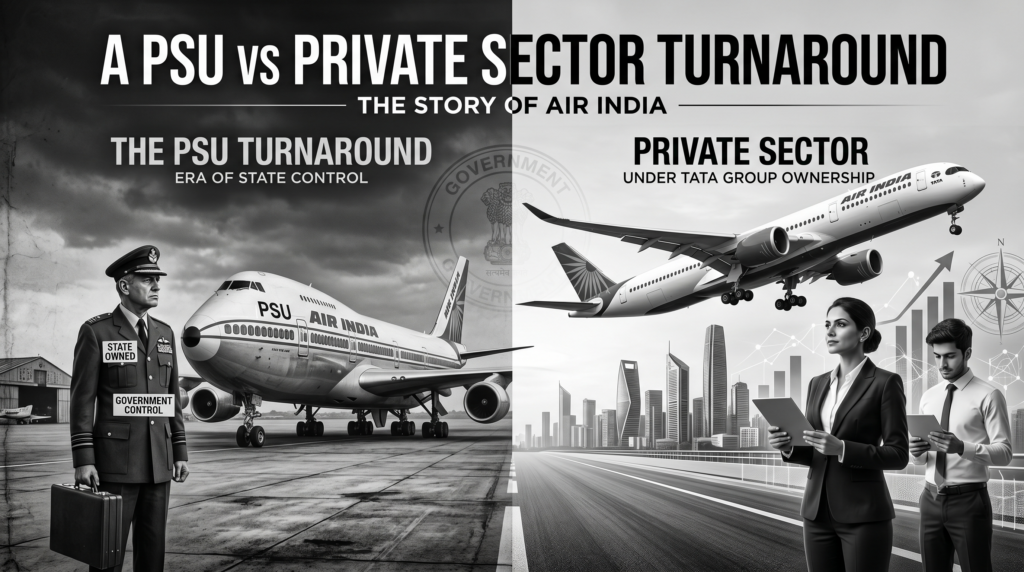
How Ownership, Governance, and Incentives Changed the Airline’s Trajectory
Executive Summary
Air India’s journey from a loss-making state-owned enterprise to a revitalized private carrier represents one of the most significant corporate turnaround stories in aviation history. For nearly seven decades under government ownership, the airline accumulated losses exceeding $9.5 billion, suffered from chronic underinvestment, bureaucratic governance, and operational inefficiency. The privatization in January 2022, when Tata Group re-acquired the carrier it had founded in 1932, marked the beginning of a dramatic transformation. Within three years, the airline posted its biggest profit in over a decade, reduced net losses from ₹7,000 crore in fiscal year 2021 to ₹1,050 crore in fiscal year 2024, and achieved an improvement in EBITDA margin from -25.3% to positive territory. The Air India case offers compelling evidence that ownership structure, governance mechanisms, and incentive alignment can fundamentally alter an organization’s trajectory, even in industries facing structural challenges.
Section 1: Historical Context and Background
1.1 The Origins: Tata’s Founding Vision
Air India traces its roots to Tata Airlines, founded in 1932 by J.R.D. Tata, who recognized the potential of aviation to connect India’s vast geography. The airline began operations with a single aircraft flying mail between Karachi and Ahmedabad, quickly expanding to passenger services. The early years demonstrated what private ownership and entrepreneurial vision could achieve in Indian aviation. Tata’s personal attention to service quality, operational efficiency, and employee welfare established standards that would later become part of the airline’s legendary reputation.
In 1946, the company was renamed Air India and began international operations, becoming one of the first airlines to fly jets across the Atlantic and Pacific. By 1953, when the Indian government nationalized the airline under the Air Corporations Act, Air India had established itself as a respected international carrier with a reputation for excellent service and operational excellence. The Maharaja, as the airline’s mascot came to be known, became one of India’s most recognizable brand icons worldwide.
1.2 The Nationalization Era: Seven Decades of State Ownership
The decision to nationalize Air India reflected the broader economic philosophy of the post-independence Indian state, which viewed strategic industries as too important to be left to private enterprise. The government acquired 100% ownership, with the stated objective of ensuring that air travel served national development goals rather than private profit motives. However, the transformation from a privately-owned, entrepreneurially-managed airline to a state-owned enterprise would prove to be a pivotal turning point in the carrier’s history.
Under government ownership, Air India faced a fundamentally different set of pressures and constraints. The airline was expected to serve social objectives, including connecting remote regions, maintaining employment levels, and providing services that might not be commercially viable. Successive governments viewed the airline as a national asset to be preserved rather than a commercial enterprise to be optimized. This orientation would create structural challenges that would accumulate over decades.
The competitive landscape changed dramatically after India’s economic liberalization in 1991. New private airlines entered the market with lower cost structures, more agile operations, and greater willingness to take risks. Air India, burdened by legacy costs, bureaucratic decision-making, and political interference, found itself increasingly unable to compete effectively. The gap between the airline’s cost structure and its competitors widened steadily, translating into mounting financial losses that would eventually total nearly $10 billion.
Section 2: The Problem Diagnosis
2.1 Financial Performance Under PSU Ownership
The financial deterioration of Air India under state ownership followed a predictable pattern of decline. Annual losses that might have been manageable in the early years became catastrophic as competitive pressures intensified. By the time the government finally decided to divest the airline in 2021, Air India had accumulated debts and accumulated losses that made it one of the world’s most indebted airlines.
The scale of the problem was staggering. Government data revealed that the airline was losing approximately $2.6 million every single day. The accumulated losses had reached ₹95 billion (approximately $9.5 billion at exchange rates of that period), a figure that dwarfed the airline’s asset base and made continued government support increasingly untenable. Taxpayer money flowing into the airline had become a permanent feature of the federal budget, creating a fiscal burden that government officials could no longer ignore.
The financial statements told a story of systematic erosion. Revenue growth lagged behind market expansion, as Air India lost market share to more agile competitors. Operating costs remained stubbornly high, reflecting labor agreements, legacy infrastructure, and organizational practices that had never been subjected to competitive discipline. The airline’s fleet, once among the most modern in Asia, had aged without adequate replacement. Maintenance costs climbed as aging aircraft required increasingly expensive upkeep. Meanwhile, passenger experience declined, driving away customers who had alternatives.
2.2 Operational Inefficiencies and Service Deterioration
Beyond the financial metrics, Air India suffered from operational problems that compounded its commercial difficulties. The airline developed a reputation for unreliable operations, with on-time performance consistently ranking among the worst in the industry. Flight delays and cancellations became so frequent that they were almost expected by regular travelers. Baggage handling problems, including lost and damaged luggage, further damaged the airline’s reputation.
The customer experience declined to the point where Air India became a byword for poor service in the Indian aviation market. Aircraft interiors were dated, with entertainment systems that had not been upgraded in years. Cabin crew motivation appeared low, reflecting the broader atmosphere of institutional malaise. The legendary hospitality that had characterized the airline under Tata ownership seemed like a distant memory, replaced by an experience that passengers endured rather than enjoyed.
These operational problems were not simply matters of management attention or resource constraints. They reflected deeper structural issues rooted in how the organization was governed, how employees were motivated, and how decisions were made. The absence of market discipline meant that poor performance had few consequences. The absence of competitive pressure meant that improvements had few rewards. The incentive structure systematically discouraged excellence.
2.3 Governance Failures and Bureaucratic Constraints
Perhaps the most fundamental problem with Air India under state ownership was governance. The airline was run as an extension of government, with all the dysfunction that this implied. Senior management positions were often filled by Indian Administrative Service (IAS) officers with no aviation experience, who viewed their posting as a career step rather than a professional commitment. The lack of continuity in leadership meant that long-term strategy was impossible to formulate and implement.
The board of directors, composed largely of government nominees, provided limited oversight. Meetings focused on compliance with government procedures rather than strategic guidance. Financial decisions required multiple layers of approval, often including ministerial sign-off, making it impossible to respond quickly to market opportunities or challenges. Capital expenditure decisions, even for relatively modest items, could take months or years to navigate the approval process.
Political interference compounded these bureaucratic constraints. Routes were maintained for political reasons rather than commercial logic. Employment levels were preserved regardless of operational needs. Purchasing decisions were influenced by considerations unrelated to airline operations. The result was an organization that could not respond effectively to its environment, constrained by governance mechanisms that had been designed for a very different kind of institution.
2.4 Human Resource Challenges
Air India’s workforce, once a source of competitive advantage, had become a liability. The airline was significantly overstaffed relative to its operations, with employee counts that exceeded industry benchmarks by a substantial margin. Labor agreements embedded work rules that prevented productivity improvements. The absence of performance-based incentives meant that there was little reward for exceptional effort or consequence for poor performance.
The employee base was aging, with many workers having spent their entire careers at the airline without the pressure to develop new skills or adapt to changing circumstances. Training investments were minimal, reflecting both cost constraints and the absence of competitive pressure to improve service quality. Morale had declined to the point where many employees seemed resigned to the airline’s decline rather than invested in its success.
Notably, the government had attempted to address some of these issues through periodic revival plans, but the fundamental ownership structure remained unchanged. Each plan achieved limited and temporary improvements before the underlying problems reasserted themselves. The conclusion that most observers reached was that only a change in ownership and governance could address the root causes of Air India’s dysfunction.
Section 3: The Privatization Process
3.1 Government’s Decision to Divest
The Indian government’s decision to divest Air India followed years of hesitation and failed attempts. Previous governments had considered privatization but retreated in the face of political opposition, particularly from labor unions and nationalist sentiment that viewed the sale of the national carrier as a betrayal of national heritage. The airline’s iconic status made it a symbol beyond its commercial significance, complicating the divestment calculus.
The government of Prime Minister Narendra Modi approached the question differently. Buoyed by political success and committed to economic liberalization, the administration framed the divestment as necessary for the airline’s survival and for the efficient use of taxpayer resources. The finance ministry, in particular, had become increasingly concerned about the ongoing drain on public finances. The argument that the government could not afford to continue propping up a loss-making airline resonated with policymakers facing competing demands for scarce resources.
The decision to proceed with divestment was not without controversy. Labor unions protested, fearing job losses and changed working conditions. Some political opponents argued that the government was selling a national asset at too low a price. Media coverage oscillated between criticism of the sale’s terms and recognition that the airline’s continued deterioration made action necessary. Despite these concerns, the government pushed forward, believing that the costs of inaction exceeded the risks of divestment.
3.2 Structuring the Transaction
The transaction structure was designed to make Air India attractive to potential buyers while protecting government interests. The government decided to sell 100% of the airline, including its substantial debt, rather than a partial stake that would leave it with ongoing exposure to the airline’s losses. The airline’s valuable assets, including landing slots at major international airports and valuable routes, were retained within the entity being sold.
The debt burden that transferred to the buyer was substantial. Tata Group, the winning bidder, would assume approximately ₹46,000 crore in debt as part of the transaction. To compensate for this burden, the government offered the buyer access to Air India’s assets and rights that had significant value. The airline’s international route authorities, its presence at slot-controlled airports like London Heathrow and New York JFK, and its brand recognition represented potential sources of value that a competent operator could unlock.
The bidding process attracted interest from several parties, including domestic airlines, international carriers, and financial investors. However, the complexity of the transaction, the scale of the debt, and the challenges of turning around such a troubled airline limited the field of serious contenders. Tata Group emerged as the winning bidder with an offer of ₹18,000 crore, significantly above the reserve price that the government had set.
3.3 Tata Group’s Strategic Rationale
For Tata Group, the acquisition of Air India represented both a sentimental return to roots and a strategic business opportunity. J.R.D. Tata had founded the airline nearly ninety years earlier, and the Tata family maintained a sense of connection to the carrier that persisted even after seven decades of government ownership. The opportunity to reclaim the airline and restore it to its former glory carried appeal beyond purely commercial considerations.
Strategically, the acquisition aligned with Tata Group’s ambitions in the aviation sector. The group already operated Vistara, a premium airline that had established itself as India’s most highly-rated carrier. Adding Air India would create a platform for competing across market segments, from budget to premium service. The combination of Air India’s international route authorities and Vistara’s domestic strength would create a more comprehensive competitive offering than either airline could achieve alone.
Tata Group also recognized that India’s aviation market was growing rapidly and would become one of the world’s largest over the coming decades. The opportunity to own a major airline positioned to benefit from this growth had significant long-term value. Even accounting for the challenges of turning around Air India’s operations, the strategic rationale for the acquisition appeared sound to Tata Group’s leadership.
Section 4: Tata Group’s Transformation Strategy
4.1 Immediate Stabilization Actions
Tata Group moved quickly after taking control in January 2022 to stabilize the airline and begin the turnaround process. The immediate priority was addressing the most visible operational problems that were damaging the brand and driving away customers. Reliability improved as maintenance protocols were tightened and operational procedures were reformed. On-time performance, which had been among the worst in the industry, began to show measurable improvement.
The new management team also focused on addressing employee concerns and beginning the process of cultural change. Unlike previous attempts at reform that had focused primarily on cost-cutting, Tata Group signaled an intention to invest in the airline while also improving efficiency. Employee communication improved, with clearer articulation of expectations and greater transparency about the challenges ahead. The message from leadership was that turnaround required everyone’s involvement, not just management decisions.
Financial stabilization was equally critical. Tata Group arranged financing to meet the airline’s immediate obligations and began the process of restructuring relationships with suppliers and creditors. The group’s strong balance sheet and banking relationships provided credibility that the previous management had lacked. Vendors who had grown accustomed to slow payment began to see improvement, restoring supplier confidence and improving the airline’s access to critical services.
4.2 The Vihaan.AI Transformation Plan
In September 2022, Air India unveiled its comprehensive transformation plan, named “Vihaan.AI” (Vihaan means “dawn” or “to fly” in Sanskrit). The plan established clear objectives for the airline over a five-year horizon, addressing every aspect of the business from fleet and network to customer experience and organizational capability. The plan represented a complete rethinking of how the airline should operate and compete.
The fleet transformation was perhaps the most ambitious element of Vihaan.AI. The plan called for dramatically expanding and modernizing the aircraft fleet, recognizing that Air India’s competitive position depended on having reliable, fuel-efficient, and passenger-appealing aircraft. The existing fleet had aged significantly, with many aircraft well beyond their optimal service lives. New aircraft would improve both operational reliability and passenger experience while reducing fuel costs.
Network expansion was another priority. The plan targeted significant growth in both domestic and international routes, leveraging Air India’s valuable international route authorities that had been underutilized under government ownership. The objective was to increase domestic market share to more than 30% and achieve comparable growth in international markets. This expansion would require not just aircraft but also people, systems, and infrastructure to support the growth.
Customer experience improvement was positioned as central to the transformation. Air India had fallen far behind competitors in the quality of the onboard experience, and reversing this decline would be essential to winning back customers who had migrated to other airlines. The plan called for comprehensive upgrades to cabin interiors, entertainment systems, food service, and customer service processes. Technology investments would support these improvements while also enhancing operational efficiency.
4.3 Brand Revival and Visual Identity
A critical element of the transformation was reviving the Air India brand, which had suffered from years of neglect and negative associations. The new management recognized that the Maharaja mascot and the airline’s historic identity retained strong recognition and emotional resonance, but these assets needed to be repositioned for a modern audience. The brand refresh was designed to honor the airline’s heritage while signaling a new era of quality and ambition.
The visual identity redesign represented a significant departure from the previous look. The new color scheme, incorporating deeper shades of red and gold along with a contemporary palette, was intended to evoke both Indian heritage and global sophistication. The iconic Maharaja mascot was retained but reimagined in a more contemporary style. The new livery, applied across the fleet, created a visual statement that the airline had changed.
Brand communication shifted as well, with Air India positioning itself as a premium global carrier rather than a struggling national airline. Marketing campaigns emphasized quality, reliability, and the airline’s Indian identity as a source of strength rather than limitation. The messaging tried to recapture the pride that had once characterized the Air India brand while acknowledging the need to earn customer trust again.
4.4 Fleet Investment and Expansion
In February 2023, Air India announced what would become one of the largest aircraft orders in aviation history. The airline committed to purchasing 470 aircraft from Airbus and Boeing, including 250 Airbus aircraft (140 A320neo, 70 A321neo, and 40 A350 widebody aircraft) and 220 Boeing aircraft (190 737 MAX and 30 787 Dreamliner). The combined value of the order was estimated at over $70 billion at list prices, though airlines typically negotiate substantial discounts.
This order represented a dramatic transformation of Air India’s fleet strategy. The airline had essentially stopped buying new aircraft after 2005, instead relying on leasing and extending existing aircraft lives. The new order would not only replace aging aircraft but also enable significant capacity expansion. The widebody aircraft would strengthen international operations, while the narrowbody order would support domestic growth and expand short-haul international routes.
The selection of aircraft types reflected careful analysis of operational requirements and market opportunities. The Airbus A350 and Boeing 787 would serve long-haul international routes, competing directly with carriers like Emirates, Qatar Airways, and Singapore Airlines. The A320neo and 737 MAX families would form the backbone of domestic operations and short-haul international services, offering the fuel efficiency and operational flexibility that the Indian market required.
Section 5: Organizational and Cultural Transformation
5.1 Governance Restructuring
One of the most significant changes following Tata Group’s takeover was the restructuring of governance arrangements. The airline moved from a model where government appointees made decisions subject to political oversight to a more conventional corporate governance structure with clear lines of accountability and professional management. The board became focused on strategic guidance and oversight rather than compliance with government procedures.
The appointment of Campbell Wilson as CEO represented a break from tradition. Wilson was an experienced airline executive who had previously led Scoot, the low-cost subsidiary of Singapore Airlines, through a successful transformation. His experience in turning around a budget airline and his understanding of Asian aviation markets made him well-suited to lead Air India’s revival. Crucially, his appointment reflected a commitment to professional management over political patronage.
Decision-making authority was streamlined, enabling faster responses to market conditions. The layers of approval that had slowed every significant decision were eliminated or reduced. Management could make operational decisions without waiting for government clearance. Financial authority was delegated appropriately, enabling departments to function efficiently. These changes, while less visible than aircraft orders or route launches, were essential to enabling the broader transformation.
5.2 Human Capital Restructuring
The workforce transformation under Tata Group was perhaps the most sensitive and challenging aspect of the turnaround. The airline had been significantly overstaffed relative to its operations, and improving efficiency would require reducing headcount. However, Tata Group approached the restructuring with sensitivity, avoiding the aggressive job cuts that many had anticipated and instead focusing on natural attrition and voluntary separation programs.
The emphasis on natural attrition meant that the workforce would gradually align with operational requirements without the trauma of large-scale layoffs. Employees were offered voluntary retirement schemes with attractive terms, and many chose to exit during the early months of the new ownership. The average age of the workforce began to decline as older employees departed and new hires brought fresh skills and perspectives.
New hiring brought in talent with relevant skills and, importantly, a service-oriented mindset. Air India had been losing capable employees to competitors who could offer better compensation and career prospects. Tata Group reversed this trend by offering competitive compensation packages and clear career paths. The message to the market was that Air India was becoming a place where talented people could build careers, not just a employer of last resort.
Training and development investments increased substantially. The previous culture of minimal training investment gave way to recognition that employee development was essential to service quality. Cabin crew received extensive training on hospitality standards. Ground operations staff learned new procedures. Technical personnel developed skills on the new aircraft types entering the fleet. These investments signaled that Tata Group was serious about building organizational capability, not just cutting costs.
5.3 Incentive Alignment
A fundamental change under private ownership was the alignment of incentives. In the PSU environment, performance had little connection to individual reward. Managers had limited authority and limited accountability. Employees faced few consequences for poor performance and few rewards for excellence. The incentive structure systematically discouraged the effort and initiative that a competitive enterprise requires.
Tata Group introduced performance-based compensation at every level of the organization. Management compensation became tied to measurable outcomes, including operational metrics, financial results, and customer satisfaction scores. Employees throughout the organization received performance bonuses when the airline met or exceeded targets. These changes created a direct connection between individual effort and organizational success that had been absent under government ownership.
Beyond financial incentives, the broader culture began to shift. The message from leadership emphasized that every employee had a role in the turnaround and that individual actions mattered. Town halls and internal communications reinforced this message, creating a sense of shared purpose and collective responsibility. Employees who had felt disconnected from the airline’s success began to re-engage with their work and take pride in improvements they could see around them.
Section 6: Results and Performance Improvements
6.1 Financial Performance Recovery
The financial turnaround of Air India under Tata Group’s ownership exceeded the expectations of even optimistic observers. Within three years of the takeover, the airline posted its biggest profit in over a decade, a remarkable reversal from the consistent losses that had characterized its final years under government ownership. The net loss had fallen from ₹7,000 crore in fiscal year 2021 to ₹1,050 crore in fiscal year 2024, representing more than an 85% reduction in losses.
Revenue growth was even more dramatic. The airline achieved revenue growth of 249% over the period, driven by increased capacity, improved load factors, and higher yields. This growth reflected both the recovery of market share that Air India had lost to competitors and the capture of new demand in India’s rapidly expanding aviation market. The combination of volume growth and operational improvements created a powerful financial tailwind.
EBITDA margins showed similar improvement, moving from deeply negative levels to positive territory. The airline went from an EBITDA margin of -25.3% to profitability, demonstrating that the operational improvements were translating into genuine financial returns. While the airline had not yet achieved the margins of the industry’s best performers, the trajectory suggested continued improvement as the transformation progressed.
6.2 Operational Excellence
Operational performance metrics showed consistent improvement across multiple dimensions. On-time performance, which had been among the worst in the industry, improved to levels competitive with the best carriers in the Indian market. Flight cancellations decreased as maintenance reliability improved and operational processes became more robust. The airline began to develop a reputation for reliability that it had not possessed for years.
Customer satisfaction metrics showed even more striking improvement. The Net Promoter Score (NPS) jumped by over 70 points since the Tata takeover, reflecting genuine changes in customer experience rather than just recovery from a low base. Passenger reviews highlighted improvements in cabin cleanliness, crew attitude, food quality, and overall travel experience. The gap between Air India and its competitors had narrowed substantially.
The fleet modernization program contributed significantly to operational improvements. New aircraft were more reliable and more fuel-efficient than the aging planes they replaced. Dispatch reliability improved as the average age of the fleet declined. Passengers noticed the difference, with newer aircraft interiors and updated amenities contributing to higher satisfaction scores. The investment in fleet renewal was generating returns in both operational and customer metrics.
6.3 Market Position Recovery
Air India’s market share, which had declined steadily under government ownership, began to recover under Tata Group’s management. The combination of capacity expansion, service improvements, and competitive pricing helped the airline win back customers who had migrated to competitors. Market share in both domestic and international segments showed measurable improvement.
The merger with Vistara, announced in 2022 and completed in 2024, created a stronger competitive platform. The combined entity achieved a market share of approximately 24%, significantly above Air India’s standalone position before the merger. Vistara’s reputation for premium service complemented Air India’s broader network, creating a combined offering that could compete across market segments.
International expansion was a particular priority, with the airline launching 16 new international routes and significantly increasing capacity on existing services. The valuable route authorities that had been underutilized began generating revenue as Air India competed more effectively with Gulf carriers and other international airlines. The objective of becoming a genuine global competitor, not just a domestic carrier with some international services, appeared increasingly achievable.
Section 7: Analysis of Key Success Factors
7.1 The Impact of Ownership Change
The Air India case provides compelling evidence that ownership structure matters for organizational performance. Under government ownership, the airline had developed a pattern of persistent losses, declining service quality, and competitive weakness that resisted all attempts at reform within the existing ownership framework. The change to private ownership under Tata Group triggered transformation that had proven impossible under government control.
Several mechanisms explain this ownership effect. First, private ownership introduced market discipline that government ownership had removed. Tata Group could not indefinitely absorb losses without a credible path to profitability, creating pressure for the operational changes that government ownership had prevented. Second, private ownership enabled governance changes that government ownership had blocked. The new management had authority to make decisions and accountability for results that their predecessors had lacked.
Third, private ownership aligned incentives in ways that government ownership had not. The management team and employees could see that performance would be rewarded and poor performance would have consequences. This incentive alignment motivated effort and engagement that the previous environment had discouraged. The connection between individual action and organizational outcomes, which had been severed under government ownership, was restored.
7.2 Governance Transformation
The governance changes implemented under Tata Group’s ownership were essential to enabling the broader transformation. The shift from bureaucratic, compliance-focused governance to strategic, performance-focused governance created conditions under which management could actually manage. Decision-making authority was clarified and delegated appropriately. Accountability mechanisms were strengthened. Strategic clarity improved as the organization developed and communicated a coherent vision.
The appointment of experienced airline executives to leadership positions was particularly important. Campbell Wilson and his team brought expertise in airline operations, customer experience, and financial management that government appointees had lacked. They understood the aviation industry and could make informed decisions about fleet, network, and service strategies. Their credibility with employees and external stakeholders enhanced their ability to lead change.
Board governance improved as well, with directors providing genuine strategic guidance rather than rubber-stamping management decisions. The board composition reflected relevant expertise, and board discussions focused on substantive issues rather than procedural compliance. This governance improvement created a foundation for sustained performance that the previous governance model had not provided.
7.3 Strategic Clarity and Execution
The Vihaan.AI transformation plan provided strategic clarity that had been absent in previous years. Rather than pursuing multiple inconsistent initiatives or simply reacting to immediate problems, the plan established clear priorities and a coherent framework for decision-making. Every major investment and organizational change could be evaluated against the plan’s objectives, ensuring consistency and focus.
The plan also created accountability for results. Objectives were specific, measurable, and time-bound. Progress was tracked and reported regularly. Deviations from plan were identified and addressed promptly. This disciplined approach to execution, which is standard practice in well-managed private enterprises, had been notably absent under government ownership. The transformation plan provided a roadmap and the discipline to follow it.
Execution discipline extended to resource allocation as well. Investments were prioritized based on strategic importance rather than political pressure or historical precedent. Resources flowed to the highest-value opportunities, and lower-priority activities were de-emphasized or eliminated. This discipline, enabled by governance changes and ownership commitment, ensured that resources were used effectively to support the transformation.
7.4 Cultural Change and Employee Engagement
The cultural transformation at Air India was perhaps the most challenging and the most important element of the turnaround. Changing the behaviors, attitudes, and assumptions of thousands of employees is inherently difficult, and the airline’s culture had become deeply embedded over decades of government ownership. Tata Group’s approach combined clear expectations with genuine investment in employee development and welfare.
Communication played a key role in the cultural change. Leadership regularly communicated the vision, strategy, and progress of the transformation to employees at all levels. Town halls, internal publications, and management interactions created a sense of transparency and shared purpose. Employees understood what was expected of them and why, enabling them to align their individual efforts with organizational objectives.
Recognition and reward systems reinforced the cultural change. Employees who exemplarily demonstrated the desired behaviors were recognized and rewarded, creating role models and incentives for others. The message was clear: excellence would be acknowledged and rewarded, while poor performance would have consequences. This shift in the implicit contract between employer and employee fundamentally changed the organizational dynamics.
Section 8: Lessons and Implications
8.1 Lessons for PSU Transformation
The Air India case offers several lessons for governments and policymakers considering the transformation of state-owned enterprises. First, ownership matters. The case demonstrates that changing ownership can unlock transformation that is impossible within the existing ownership structure. For enterprises that have failed to improve despite multiple attempts at reform, privatization or other ownership changes should be seriously considered.
Second, governance changes are essential. Ownership change alone is insufficient if governance mechanisms remain dysfunctional. The Air India transformation succeeded because Tata Group implemented governance changes that enabled strategic management and accountability. Private ownership without these governance changes would likely have produced disappointing results.
Third, workforce transformation requires sensitivity. The Air India case shows that workforce restructuring can be accomplished without the trauma of mass layoffs, through natural attrition, voluntary separation, and careful communication. Employees can be treated with dignity while still implementing the efficiency improvements necessary for competitiveness.
8.2 Broader Implications for Public Policy
The Air India case has implications beyond the aviation industry for public policy toward state-owned enterprises. The case suggests that governments should be realistic about what government ownership can achieve in competitive industries. State ownership introduces structural constraints on performance that may be impossible to overcome without ownership change.
The case also suggests that divestment can be structured to protect legitimate public interests while enabling private-sector performance. Air India’s valuable route authorities, brand heritage, and operational assets were transferred to private ownership in a way that preserved their value and enabled future investment. The government received significant proceeds and eliminated an ongoing fiscal burden. These outcomes demonstrate that well-structured divestments can serve both public and private interests.
However, the case also raises questions about the appropriate scope of privatization. Air India had become unable to serve its social objectives under government ownership precisely because the burden of those objectives had contributed to its commercial decline. The challenge for policymakers is to find ways to achieve legitimate social objectives without undermining commercial viability, whether through direct government provision or carefully designed public-private arrangements.
8.3 Implications for Corporate Strategy
For business leaders, the Air India case offers insights into transformation management and turnaround execution. The case demonstrates that even severely distressed enterprises can be transformed with the right combination of strategic clarity, governance improvement, and execution discipline. The scale of Air India’s problems might have suggested that turnaround was impossible, but the results prove otherwise.
The case also highlights the importance of credibility and consistency in transformation leadership. Tata Group’s reputation and track record gave employees, customers, and other stakeholders confidence that the transformation would succeed. This credibility enabled employee engagement, customer loyalty, and supplier cooperation that a less credible owner might not have achieved.
The fleet investment decision offers a lesson in bold strategic action. The $70 billion aircraft order was controversial, with skeptics questioning whether such aggressive expansion was prudent. The results to date suggest that the boldness was appropriate, capturing growth opportunities that more cautious approaches would have missed. The lesson is that transformation sometimes requires big bets, not just incremental improvements.
Conclusion
Air India’s transformation from a struggling state-owned airline to a revitalized private carrier represents one of the most significant turnaround stories in aviation history. The case demonstrates that ownership, governance, and incentives fundamentally shape organizational performance, and that changing these factors can unlock transformation that had proven impossible within existing structures.
The results speak for themselves. Financial losses have been dramatically reduced, with the airline posting its biggest profit in over a decade. Operational performance has improved dramatically, with on-time performance and customer satisfaction reaching levels competitive with the best carriers in the Indian market. Market position has recovered, with market share increasing and international expansion accelerating.
Yet the transformation is not complete. The airline still faces significant challenges, including the integration of the Vistara merger, the massive fleet modernization program, and the ongoing effort to build a sustainable competitive position in a challenging industry. The early results are encouraging, but long-term success will require continued discipline and execution.
The Air India case offers lessons that extend well beyond the aviation industry. For governments considering the transformation of state-owned enterprises, the case demonstrates that well-structured privatization can serve both public and private interests. For business leaders managing turnarounds, the case illustrates the power of strategic clarity, governance improvement, and disciplined execution. For scholars of organizational performance, the case provides a natural experiment in the effects of ownership, governance, and incentives on enterprise outcomes.
The story of Air India is ultimately a story about possibilities. Possibilities for transformation even in the most challenging circumstances. Possibilities for creating value through strategic investment and operational excellence. Possibilities for reconciling national heritage with global competitiveness. The airline that J.R.D. Tata founded in 1932 faced many challenges over its first century, but the most dramatic challenge came in its seventh decade of government ownership. The resolution of that challenge, through privatization and transformation, may prove to be the most significant chapter in the airline’s history.