
Why do educated elites keep defending Marxist fantasies despite a century of failure?
I. Revolutions in Air-Conditioned Rooms
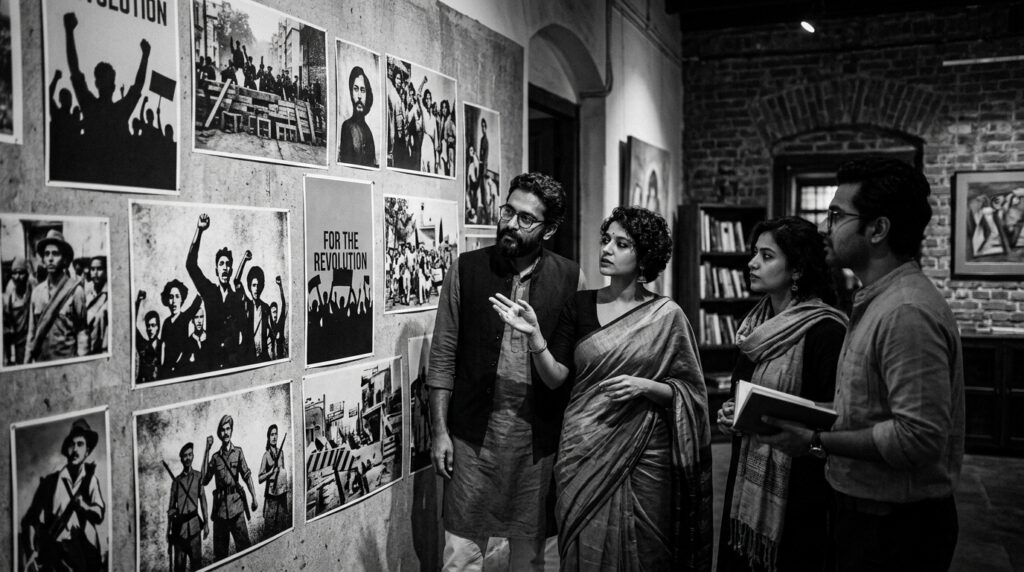
Picture the scene: a literary festival in Jaipur, or a conference hall in JNU, or a seminar room on a private university campus in Pune. The topic is “People’s Resistance and the Future of Indian Democracy.” A professor from a top institution speaks in careful, measured tones about “revolutionary praxis.” A poet in a Nehru jacket quotes Gramsci. An activist-filmmaker reads from a banned Maoist pamphlet to appreciative murmurs. The speakers are well-dressed, well-fed, and well-paid. None of them live in Bastar. None of them will be travelling by night through a forest that the Naxalites have seeded with IEDs. None of their children attend schools that a “people’s liberation squad” has burned to the ground because a functioning school represents the Indian state’s “encroachment on a liberated zone.”
This is the fundamental obscenity at the heart of India’s progressive intellectual culture: the revolution is always happening to someone else.
For more than five decades, a substantial section of India’s educated elite — located in universities, mainstream media, NGOs, publishing houses, literary journals, and human rights organisations — has maintained a sentimental attachment to Marxist and Maoist political fantasies. They denounce “state violence” with precision and urgency; they describe guerrilla organisations that murder teachers, rape tribal women, extort farmers, and blow up railway lines as “resistance movements.” They call India’s security forces fascist while defending an ideology that produced — by the most conservative scholarly estimates — over 100 million deaths worldwide across the twentieth century.
This editorial is an attempt to explain how this intellectual perversion came to be, why it persists, and what it actually costs the Indians who cannot afford to romanticise it.
II. The Roots of the Romance: Moscow, Nehru, and the Anti-Colonial Detour
To understand why India’s intellectuals romanticise Marxist revolution, you must first understand that the romance was not spontaneous — it was, in significant part, manufactured, cultivated, and financially supported by the Soviet Union over several decades.
The seduction began early. For Indian nationalists fighting British colonialism, the October Revolution of 1917 arrived as a thrilling vindication. Here, at last, was a European power that seemed to stand against empire, against capital, against the very architecture of British domination under which India suffered. Jawaharlal Nehru — who would become India’s first prime minister — declared without hesitation that the Soviet revolution had “advanced human society by a great leap and had lit a bright flame which could not be smothered,” even as he privately acknowledged Stalinist repression.
What followed was one of the most successful influence operations in modern intelligence history. The Mitrokhin Archive — the most comprehensive record of KGB activities ever to emerge from the Soviet Union, compiled by defector Vasili Mitrokhin — reveals in granular detail how the KGB penetrated Indian politics, media, and intellectual life at the highest levels for decades. The KGB’s New Delhi residency was one of the most operationally active in the entire world. By the 1970s, the KGB was placing thousands of articles annually in the Indian press through agents and “confidential contacts.” In 1976 alone, 1,980 such planted articles appeared in Indian newspapers and journals. After political changes made the environment harder, that number dropped to 411 in 1977 — but the operation never stopped.
Indian intellectuals were systematically cultivated. KGB officers posing as cultural diplomats, journalists, and academics befriended professors at Delhi University, wined and dined literary figures at Moscow-funded events, and invited carefully pre-selected “progressive intellectuals” on all-expenses-paid tours of the Soviet Union, where every sight was stage-managed. Yuri Bezmenov, a former KGB operative stationed at the Soviet Embassy in New Delhi who later defected to the West, described his own role with devastating clarity. His job was to accompany what he called “so-called progressive intellectuals — writers, journalists, publishers, teachers, professors” on Novosti-organised tours. He kept them “permanently intoxicated” from the moment they landed at Moscow Airport — a deliberate technique to lower their critical guard — then took them to purpose-built showcase facilities, and approached the most “recruitable” when they were disoriented. “For us,” Bezmenov said bluntly, “they were just a bunch of political prostitutes to be taken advantage of for various propaganda operations.”
The Mitrokhin files document KGB subsidies of millions of rupees channelled to the Communist Party of India through a secret front business. The Soviet news agency Novosti routinely paid the CPI publishing house at fifty percent above market rates — a covert subsidy hidden in plain sight. The General Secretary of the CPI was summoned to the Soviet Embassy on the eve of elections to receive instructions from the CPSU Central Committee on which political positions to adopt. One famous Indian poet, Sumitra Nandan Pant, was celebrated as an honoured guest in Moscow specifically because he was the author of a poem titled “Rhapsody to Lenin.”
None of this was friendship. It was an operation. And it worked. Several generations of India’s educated class were trained to see the world through a lens that Moscow had ground for them. Soviet socialism was the beacon; America was imperialism; non-alignment was virtue. These habits of mind became embedded in university curricula, in student union ideology, in the tacit assumptions of polite liberal dinner-party conversation. By the time the Soviet Union collapsed, the intellectual infrastructure it had built in India — across universities, the media, the NGOs, the publishing world — had become entirely self-sustaining. It no longer needed Soviet money. It had captured the means of cultural reproduction.
III. From October to Naxalbari: When Fantasy Met Reality
The domestic expression of this romance took its most violent and revealing form in the Naxalite movement, which erupted in May 1967 in the Naxalbari area of north Bengal’s Darjeeling district — and has never truly ended.
The historical context matters. In 1966 and 1967, India was in genuine agrarian crisis. Nearly forty percent of the country’s cultivated land was held by just five percent of rural households. Tenant farmers paid rents amounting to fifty, sixty, sometimes seventy or eighty percent of their crop. Landless labourers lived in states of effective serfdom. The food shortage of 1966-67 — the first famine declaration in independent India, in Bihar — was not merely a natural disaster; it was a product of a system where big landlords were “hoarding their surplus produce to sell at huge profit” while State procurement machinery was “often in league with local big farmers.” The grievances that fuelled Naxalbari were real, legitimate, and rooted in documented structural injustice.
What is crucial is what the Naxalite leadership chose to do with those legitimate grievances. Rather than organising for land reform within India’s constitutional framework, Charu Mazumdar and his associates imported wholesale the strategy of Mao Zedong: armed “people’s war,” guerrilla units, the “annihilation” of class enemies, and the creation of “liberated zones.” Mazumdar explicitly rejected all electoral participation, all trade union work, all mass organisation as “revisionism.” He urged the youth not to “waste their energy passing examinations” but to join the armed struggle immediately. Radio Peking endorsed the Naxalbari uprising as “the front paw of the revolutionary armed struggle launched by the Indian people under the guidance of Mao Tse-tung” — a Chinese endorsement that was not incidental. The Naxalite leadership was proudly subordinating its strategy to Mao’s China, a regime that had by this time already murdered tens of millions through the Great Leap Forward.
But what mattered to the urban intellectual class of Calcutta and Delhi was not the body count in Hunan. What mattered was the romance. Young students from middle-class bhadralok families — at Presidency College, Jadavpur, and campuses across Bengal — burned with excitement. Walls in Calcutta’s College Street were plastered with slogans: “The path of Naxalbari is the path of peasants’ revolution!” Groups of middle-class students wrote revolutionary tracts and went to the villages, not to listen to the poor, but to teach them the correct ideology.
The Naxalbari uprising was crushed within months. Its leaders, in their own post-mortems, admitted fundamental failures. Kanu Sanyal wrote in self-criticism: “We assumed that the base area had been created. We took the armed people for an armed force… In one or two cases, we were impressed by the militant attitude of vagabonds, and made them leaders.” The movement had “failed to establish a powerful mass base” precisely because its leaders had rejected mass organisation as revisionist.
None of this produced reflection in the urban intelligentsia. It produced more poetry.
IV. The Architecture of Ideological Sympathy: Campus, NGO, Media
The Naxalite insurgency learned early what its Soviet ideological predecessors knew: guns in the forest need pen-pushers in the city. You cannot sustain a guerrilla insurgency without an ecosystem of intellectual legitimation that delegitimises the state, discredits security operations, and keeps the international narrative tilted in your favour.
The result is the “urban Naxal” phenomenon: a network of academics, lawyers, human rights activists, NGO workers, journalists, and cultural figures who provide intellectual cover, legal defence, fundraising, and communications support for an organisation classified by the Government of India as a terrorist outfit. The term is contested, and has been applied imprecisely; but the core phenomenon it describes — a systematic relationship between an armed Maoist insurgency and its urban support network — is documented and real.
Filmmaker Vivek Agnihotri, who made the film “Buddha in a Traffic Jam” exploring Naxalism’s intellectual ecosystem, described in detail the systematic obstruction encountered when trying to screen the film at elite Indian universities — IIT, JNU, Jadavpur, TISS. Last-minute venue cancellations. Faculty interventions. Administrative pressure. Student union mobilisation. The film, which neither glorified security forces nor denied the genuine poverty Naxalism exploits, was treated as heresy precisely because it refused the romance the campuses demanded.
The broader intellectual asymmetry is stark. Human rights organisations that document state violence against Naxal suspects — which is legitimate and necessary work — routinely decline to document Naxal atrocities against the very communities they claim to represent. Academics producing nuanced analyses of “structural violence” in the Red Corridor seldom produce equally nuanced analyses of the Maoist practice of executing village headmen who cooperate with development programmes, or blowing up schools built by state authorities. The asymmetry is not scholarly. It is ideological. And it has consequences: when an operation against Maoist leadership produces civilian casualties, it generates enormous coverage and legal activism; when Naxalites killed 76 CRPF personnel in a single ambush at Dantewada in April 2010, the progressive response was either silence or a rapid pivot to “contextualising the violence as a symptom of structural oppression.”
V. The Global Death Toll and the Indian Dodge
It is necessary to state the historical record plainly, because the intellectual culture under scrutiny has cultivated, over decades, a remarkable immunity to it.
Communist regimes in the twentieth century were responsible for between 100 and 170 million deaths. The USSR murdered between 20 and 62 million of its own citizens through the Gulag system, mass executions (approximately 950,000 to 1.2 million killed in the Great Terror of 1937-38 alone), forced collectivisation, and the engineered Holodomor famine that killed between 4 and 7 million Ukrainians. Mao Zedong’s China killed between 65 and 76 million, including the 30 to 45 million deaths of the Great Leap Forward famine. The Khmer Rouge murdered approximately two million people — roughly a quarter of Cambodia’s entire population — in under four years.
The socialist economics that underpinned these regimes produced what Ludwig von Mises had predicted: chronic shortage, chronic misallocation, and the systematic inability of central planners to allocate resources efficiently in the absence of price signals. By the 1980s, Soviet citizens were standing in queues for basic bread in cities that had experienced a century of industrial development. Collectivised agriculture could not feed the population it was supposed to liberate.
India’s progressive intellectuals know this history. The information is not hidden. And yet the response — consistent, rehearsed, almost liturgical — is invariably some variant of: “That was not real socialism.” “Stalin/Mao/Pol Pot betrayed the revolution.” “Real socialism has never been tried.”
This deserves the intellectual seriousness it merits — which is almost none. After one hundred years, across more than two dozen separate experiments in socialist governance, conducted on six continents, in countries of wildly different cultures, histories, and development levels, not one produced the stateless, classless, humane society that Marxist theory promised. The Yugoslav dissident Milovan Djilas argued in his landmark analysis of Soviet-type systems that socialism inevitably creates a “new class” of bureaucrats who monopolise administrative control, develop their own class interests in maintaining the system’s power, and have everything to lose by advancing toward the classless society they nominally espouse. The state does not wither away. It grows.
The same people who correctly and loudly demand historical reckoning for the crimes of British colonialism maintain an almost total silence about the Gulag, the Holodomor, the Great Leap Forward, and the Killing Fields. This is not an intellectual position. It is a political allegiance dressed up as scholarship.
VI. The Psychology of Radical Chic: Why the Fantasy Survives
To explain why highly educated people persist in these fantasies despite all the evidence requires moving from the realm of ideas to the realm of incentives and psychology.
Moral vanity is the most powerful force. There is an extraordinary social reward, in certain Indian intellectual milieus, for self-identification as a “radical” thinker. It positions you, in a single gesture, above the crass materialists who run businesses, above the nationalists who wave flags, above the liberals who believe in incremental reform. A professor at an elite university, drawing a comfortable salary, sending children to private schools, living in a gated colony, can temporarily dissolve the guilt of that privilege by identifying with the revolutionary. The revolution costs nothing — it is happening far away, in someone else’s district — and it delivers a feeling of moral superiority that money cannot buy.
Institutional incentives are the second force. In Indian academia, Marxist and post-colonial frameworks have, over decades, become the dominant paradigm in humanities and social sciences. Tenure, promotion, publication, and international conference invitations are more easily secured if your work operates within these frameworks than if it challenges them. Foreign fellowships — from European and American foundations sympathetic to leftist scholarship — flow preferentially toward scholars who frame India’s problems in Marxist categories. The incentive gradient shapes careers from doctoral research onward.
Ideological subversion, in the long KGB sense of the term, is the third force. Bezmenov explained with uncomfortable precision: once the process of ideological subversion is complete, “even if you show them documented proof, even if you take them to the Soviet Union and show them concentration camps, they will refuse to believe it.” This is precisely what we observe. The Indian intellectual who defends Maoist organisations does not change his mind when presented with evidence of their atrocities. He changes his theory of what counts as evidence.
Fossilised anti-colonialism is the fourth force — a peculiarly Indian variant that has calcified into a reflexive anti-state, anti-market stance that finds any exercise of government authority suspect and any challenge to that authority romantic. This is an inheritance of the nationalist movement, where challenging state power was genuinely heroic. It has been preserved decades past its usefulness and deployed in the service of organisations whose internal governance is totalitarian, and whose vision of the future resembles nothing so much as Pol Pot’s Year Zero.
VII. The Real Cost: India’s Poor as Cannon Fodder
The ultimate test of any political ideology is what happens to the people it claims to serve.
The “Red Corridor” — the arc of Maoist influence across Chhattisgarh, Jharkhand, Odisha, Andhra Pradesh, and parts of Maharashtra and Bihar — contains some of India’s poorest and most marginalised communities: Adivasi and Dalit populations who have experienced genuine, documented, structural injustice for generations. It is precisely the legitimacy of their grievances that the Naxalite movement has exploited most ruthlessly.
Schools are burned — not by the state, but by Maoist cadres who regard a functioning school as evidence of the state’s presence and therefore a legitimate military target. Roads, bridges, and electricity infrastructure are destroyed, keeping communities in isolation not from any sophisticated theory of autonomous development, but because connectivity enables security force movement. Elected village leaders and development workers who cooperate with state programmes are assassinated as “class enemies.” The extortion economy — “revolutionary taxes” demanded from contractors, businesspeople, and even impoverished peasants — runs to thousands of crores, by the estimates of multiple state police forces. This money does not fund schools or clinics. It funds weapons, communications equipment, and the urban-based cadre infrastructure that provides the movement its intellectual respectability.
Meanwhile, the villagers who actually live in conflict zones are objects, not subjects, in the discourse produced by their supposed champions. The urban intellectual describes them in theoretical terms — “the adivasi,” “the forest people,” “the dispossessed” — but rarely listens to what those people actually say, which, in survey after survey, is that they want roads, schools, hospitals, and an end to the violence.
VIII. What Real Progressivism Would Look Like
None of this analysis requires the conclusion that India has no injustice, no structural inequality, no legitimate grievances demanding political response. It requires only the elementary intellectual honesty to distinguish between those grievances and the ideological frameworks used to exploit them.
A genuine Indian progressivism would be empirically grounded — taking seriously the evidence from development economics that markets, property rights, and institutional quality are the primary determinants of poverty reduction, while recognising the essential role of redistributive social policy in ensuring gains are broadly shared. It would be historically literate — treating Maoist and Soviet ideology with the same critical rigour applied to colonial ideology, refusing the double standard that condemns one set of atrocities while contextualising another. It would be democratically committed — insisting on the peaceful resolution of political conflicts and the prosecution of violence — whether by state forces or insurgent organisations — through the rule of law.
Most fundamentally, it would be honest about who pays the price of revolutionary fantasies. It is never the professors at elite universities. It is never the novelists short-listed for international prizes. It is never the lawyers filing public interest litigations from offices in Delhi and Mumbai. It is always the people in the villages — the adivasi woman whose son was recruited as a child soldier, the village headman shot for attending a government development meeting, the child whose school was burned on the eve of examinations.
IX. Conclusion: Grow Up
The twentieth century produced the most extensive natural experiment in political economy that human history has ever witnessed. Across dozens of countries, on every continent, under the most varied conditions imaginable, Marxist-Leninist ideology was given full state power and the opportunity to build the society it promised. The results were, without exception, authoritarian, economically dysfunctional, and in many cases genocidal. The experiment is over. The results are in.
India’s progressive elite has, in large measure, chosen not to accept these results. They have instead developed an elaborate system of immunisation against evidence: the No True Scotsman defence (“that wasn’t real socialism”), the structural alibi (“external forces prevented success”), the moral reversal (“criticising the revolution plays into the hands of imperialism”), and the romantic displacement (“but the cause is just, even if the methods were imperfect”). These are not intellectual positions. They are the psychological mechanisms of a faith that has survived the death of its god.
A revolution that always happens in someone else’s village is not solidarity. It is sadism in an intellectual mask.
India does not need more Marxist fantasies. It needs more intellectual courage — the courage to follow evidence wherever it leads, to hold all ideologies to the same standard of accountability, and to be genuinely, rather than theatrically, on the side of the poor. After a century of gulags, famines, and failed people’s wars, that is not an unreasonable demand.
It is, in fact, the minimum.