
Revolutionary movements do not primarily recruit soldiers. They recruit minds. And in India today, as in the United States of the 1950s, the most systematically targeted minds belong to university students. Understanding why requires setting aside the comfortable assumption that radicalization is a failure of intelligence. It is, in almost every documented case, a failure of context, and a predictable one.
Why Students Are the Prime Target
In 1960, J. Edgar Hoover submitted a report to Congress titled Communist Target: Youth, analyzing communist infiltration tactics at American campuses following riots at a House Committee hearing in San Francisco. His central finding was deceptively simple: the Communist Party USA knew that universities were the most cost-effective recruiting environment available, because students were simultaneously the most intellectually open, the most emotionally unanchored, and the most socially hungry of any adult demographic. The party did not need to convert a majority. It needed to capture a strategically placed minority whose prestige networks and moral intensity would do the rest.
Three connected vulnerabilities make this possible. First, students are transitionally unanchored. They have left the social networks of home and family and have not yet built the networks of career and civic life. That gap is not weakness; it is ordinary development. But it creates a window during which belonging is actively sought and communities that provide it can exercise extraordinary influence over identity formation. Second, students carry disproportionate moral energy. Questions of justice and social obligation feel most urgent at this life stage, and that energy is entirely genuine. It is also exploitable, because it creates intense receptivity to frameworks that present moral action as urgent and total. Third, students occupy a culturally prestigious position. A radicalized student is more organizationally valuable than a radicalized worker of the same number because the student’s voice carries more cultural weight, and because he will go on to become a journalist, academic, lawyer, or civil servant.
Thomas Sowell’s analysis of intellectual environments reinforces this. Educational institutions reward verbal fluency, theoretical abstraction, and the performance of intellectual seriousness. Students who excel in this environment are, by the incentive structure around them, already predisposed to value ideas over outcomes and prescription over consequence. Schumpeter, writing a generation earlier, observed that capitalism produces surplus intellectuals who find no outlet proportionate to their self-estimate within the existing order, making them structurally predisposed toward adversarial politics. The student is the earliest version of that type, at maximum ideological availability.
The Total Framework and Its Appeal
The most important thing to understand about how ideological capture works is that it does not arrive as doctrine. It arrives as explanation. At the life stage when the world is newly legible and enormously confusing, a framework that explains everything, names enemies with clarity, and defines heroes with moral precision is not repellent. It is a relief.
Whittaker Chambers described this from his own experience in Witness. He had not been looking for communism. He had been looking for a way to make sense of what looked like civilizational breakdown. Communism gave him history as a drama with known parties, a known direction, and a known resolution. That is what total frameworks offer: not ideology but relief from complexity.
For Indian students in Maoist-adjacent circuits, the total framework operates identically. Poverty, caste exclusion, adivasi displacement, police impunity, and judicial delay are all real. A framework that traces all of them to capitalism, the bourgeois state, Brahminical hegemony, and corporate land theft does not need to be accurate in every detail to feel revelatory. It needs only to give the grievance a name and a target. Once that is done, the student has a vocabulary for everything, a moral position on everything, and a community of people who speak the same language. The CPI (Maoist)’s Urban Perspective documents identify students and intellectuals as key organizational categories, emphasizing that ideological formation must precede and enable all other urban work.
The Reading Circle as a Recruitment Device
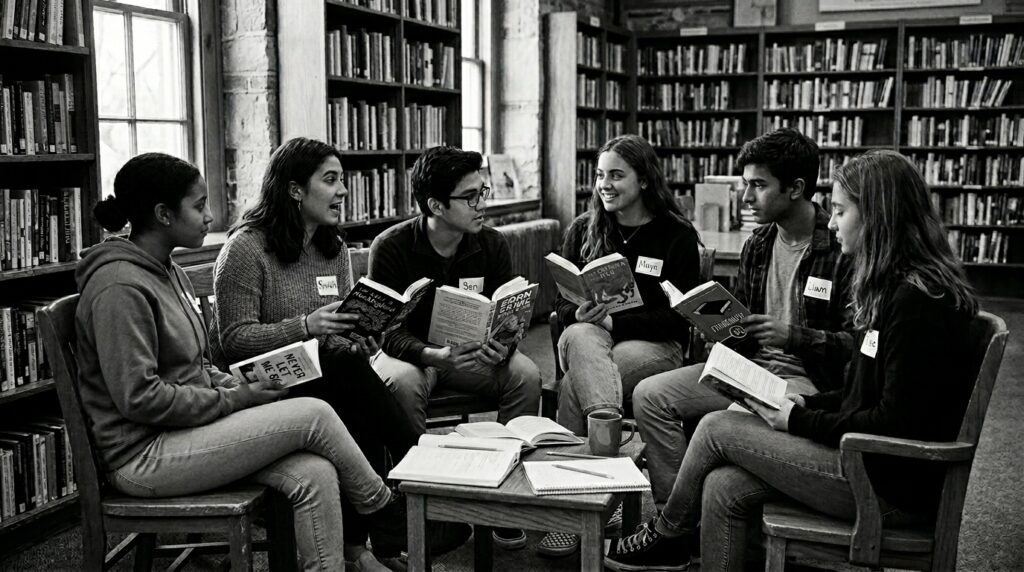
The reading circle is perhaps the most elegant recruitment mechanism ever developed for ideological purposes. It requires no formal membership, no oath, no explicit commitment, and no visible organizational structure. It requires only a selection of texts, a group of willing readers, and a facilitator who shapes the discussion. Everything else follows.
Hoover documented how the Communist Party USA used reading groups as the primary mechanism for political education and soft recruitment. The party understood that people guided through a carefully selected library of texts would, over months, have absorbed not just arguments but categories of thought, vocabulary, and a moral hierarchy that made party positions feel self-evident rather than prescribed. The reader did not feel indoctrinated. He felt educated. The effect was the same.
The selection of texts is the operative mechanism. In controlled environments, the reading list is built from one direction: texts that establish a total critique of capitalism, the state, and existing institutions. Dissenting or counter-analyses are absent, or represented only as straw men. In Indian universities, this pattern is well documented. The list typically begins with academically mainstream social science on poverty, caste, and tribal displacement, raising no immediate suspicion. It moves gradually toward texts that frame the Indian state as inherently oppressive and dissent as the only honest response. By the time explicitly Maoist material is introduced, the student has already been formed by a library that has been leading there. Vocabulary acquisition through this process is systematic. The student shifts, almost without noticing, from ordinary political analysis to the ideological shorthand of “structural violence,” “people’s movement,” “carceral state,” and “political prisoner.” Each term arrived embedded in an assigned text, not delivered as a party slogan. That is why it feels owned rather than received.
The Grievance Pipeline
The reading circle builds the interpretive lens. The campus grievance pipeline supplies the raw material. Together, they are far more powerful than either alone.
Campuses are genuinely grievance-rich environments. Hostel conditions can be poor. Administrative processes are often opaque. Caste discrimination is a documented reality in Indian higher education. Economic anxiety is persistent, especially for first-generation students from rural or lower-caste backgrounds. These grievances are real. The pipeline captures them and reroutes them.
The routing mechanism converts individual anger into collective ideology. A student angry about his hostel room does not become a Maoist operative from that grievance alone. But a student angry about his hostel room who is invited into a study group that interprets that anger as evidence of class exploitation, who meets others whose different grievances are processed through the same framework, who is told that individual solutions are either unavailable or complicit, and who is offered collective belonging and moral significance in place of personal resolution: that student is now in the pipeline.
At Jadavpur University in November 2025, the Revolutionary Students’ Front held its state conference inside the campus and symbolically renamed the city and university after killed Maoist commanders, including renaming Kolkata as “Koteshwar Rao Nagar” and the conference venue as “Hidma Stage” after a senior Maoist military commander. Security agencies noted this occurred publicly inside a campus while counterinsurgency operations were claiming major successes. The grievance pipeline and the organizational network were operating in the same physical space, in plain sight.
Heroic Identity and the Martyrology
Beyond grievance and explanation lies something more fundamentally human: the desire for a heroic self-narrative. At the life stage when identity is most actively constructed, a political movement that offers you a role in a world-historical drama is offering something that no economic argument can compete with.
The student who enters this world is no longer an ordinary person navigating an ordinary life. He is a witness, a voice for the voiceless, a morally serious person who has seen through the comfortable illusions that others accept. At Jadavpur in 2025, naming the conference stage after Hidma, who is linked to some of the deadliest attacks on security forces, was not primarily a political statement about tactics. It was a ritual of identity formation: telling students in the room who their heroes were, what kind of courage the movement admired, and what the outer limit of commitment looked like. This is not recruitment in the narrow sense. It is the construction of an aspirational identity within which harder commitment becomes both thinkable and admirable.
Sowell’s observation that intellectual environments reward the performance of moral seriousness over the delivery of practical results is precise here. The campus radical who speaks most dramatically and condemns most passionately is rewarded with peer prestige that the cautious, fact-checking student rarely receives. The incentive structure of the environment itself pushes toward radicalization as a prestige strategy.
Three Products, One Campus Investment
The endpoint of campus capture is not the same for every student. Hoover distinguished between hard-core party members, disciplined sympathizers, and fellow travellers in his broader analysis, and the same gradation applies to student capture. Not every student who passes through a reading circle becomes a cadre.
The process produces at least three distinct and useful outputs. The first is the cadre: a student who moves, through sustained organizational development, toward committed service in the movement. This is the smallest category in number but the most valuable in organizational terms. The second is the fellow traveller: a student who takes no organizational role but who has been formed enough through the reading circle and heroic identity to consistently defend, amplify, and normalize movement positions throughout a subsequent professional life. This person becomes the journalist who frames stories sympathetically, the academic who naturalizes movement vocabulary in scholarship, or the lawyer who reflexively defends movement-linked accused. He is not an operative. He is an ideological legacy produced by the campus investment. The third is the ideological repeater: a student who absorbed the vocabulary and moral map but has no organizational connection. He spreads the interpretive universe through social circles, online discussion, and family argument without knowing its origin or serving any deliberate organizational purpose. Taken collectively, this is the widest category and the most culturally significant. It is how ideological capture at the campus level becomes ideological normalization at the societal level.
The passage from reading circle to repeater is so gradual and so embedded in ordinary social and intellectual life that it rarely feels like political formation to those experiencing it. It is designed to look like education, friendship, moral growth, and intellectual development. The most important detection skill is therefore not the ability to identify an already-committed operative, but the ability to recognise the process while it is still in its early and most reversible stages.