
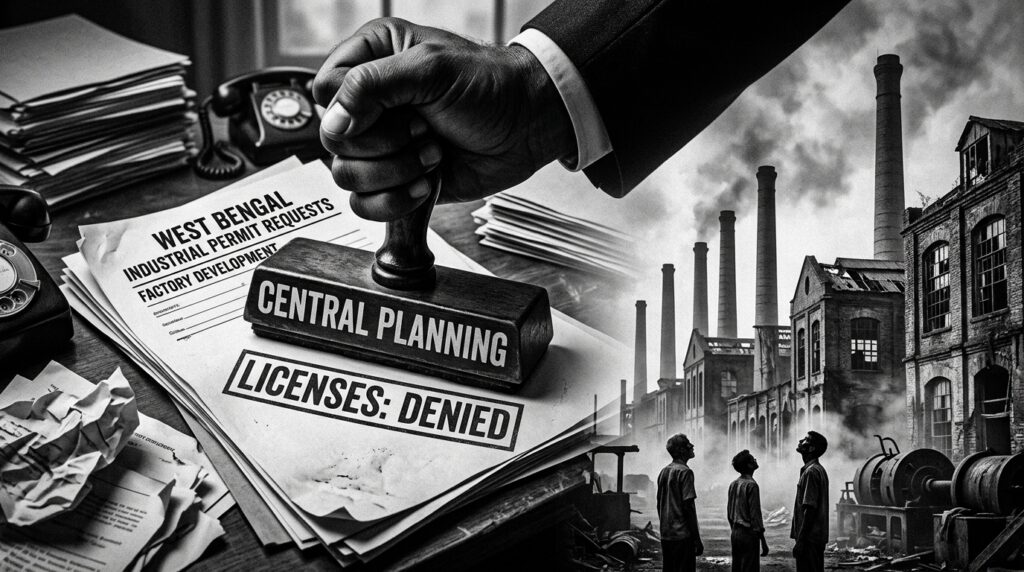
The Man Who Rewired India’s Industrial Map
T. T. Krishnamachari was no small-time bureaucrat. Between 1952 and 1958, he held in rapid succession the most powerful economic portfolios in Nehru’s cabinet: Commerce and Industry, Iron and Steel, and Finance, often simultaneously. He was, as journalist Ranajit Roy put it in The Agony of West Bengal, a man who took his work “with dead seriousness.” The problem was not his diligence. The problem was where that diligence was pointed.
In 1956, Krishnamachari made a decision that would quietly destroy the economic foundation of an entire region. He equalised the prices of iron, steel, and cement across the entire country. On paper it sounded fair. In reality it was a demolition job.
The Price Equalisation Scam
Bengal’s industrial strength had one central foundation: proximity to coal, iron ore, and other raw materials in the eastern belt. This geographic advantage meant manufacturers in Calcutta could produce at lower costs than anyone in Bombay or Madras. Krishnamachari’s price equalisation scheme simply wiped that advantage out.
The mechanism was brutal. Consumers near the production sources, that is, Eastern India, were made to pay steeply higher prices than before. Consumers far away, in Maharashtra, Gujarat, and Tamil Nadu, got the same materials at slashed rates. The state that produced the raw materials was made to cross-subsidise the industrial growth of states that produced nothing comparable. Roy described it plainly: “At one stroke he negated the advantage West Bengal and other Eastern States had for industrial development. And this was done at the cost of these States.”
The License Raj’s Bluntest Weapon
If price equalisation was the slow poison, industrial licensing was the fast-acting one. The numbers in Roy’s book are damning. Between 1956 and 1967, Maharashtra received a total of 2,741 industrial licenses. West Bengal received 1,649. This is not a marginal gap. This is a structural tilt.
In 1951, West Bengal had more registered factories than Maharashtra and Gujarat combined (which together formed bilingual Bombay State at the time). By 1965, the position had flipped entirely: Maharashtra alone had 2,834 factories, Gujarat had 1,196, and West Bengal had shrunk to just 2,036. Central licensing policy did not follow market logic or development need. It followed political geography.
The excuse given repeatedly to West Bengal was that it was “already industrialised” and therefore did not need more licenses. Roy cites industrialist B. M. Birla speaking at the New Delhi Press Club in June 1970: “The Government would not give licences for West Bengal on the plea that the State was already industrially developed.” And in the same breath, the Centre never applied this logic to Maharashtra, which was growing at pace.
The Philips Case: A Blueprint for Looting
The most clinical illustration of this policy at work is the Philips India case, documented in full in the West Bengal Government’s own letters appended to Roy’s book.
Philips’ original radio manufacturing plant was in Calcutta. In the 1950s, they opened a second factory in Poona (Maharashtra) with a licensed capacity of 12,000 sets a year. The Poona factory’s capacity was raised step by step until it reached 700,000 sets per year, with no conditions attached. The Calcutta factory, meanwhile, was allowed a licensed capacity of just 60,000 sets per year, even as it was physically producing 300,000 sets with the tacit knowledge of the Government of India.
When the West Bengal government pressed for regularisation of Calcutta’s actual production level of 300,000 sets per year, the Centre demanded a 75 percent export guarantee as a condition. No such condition was placed on Poona’s expansion to 700,000 sets. And when the state government wrote formally demanding action, the licence for Poona’s expansion was issued and then backdated to appear as if it predated the state’s letter of protest. The West Bengal Director of Industries noted in his official letter: “This naturally raises a doubt as to whether the licence was actually issued after receipt of this Directorate letter but pre-dated.”
Beyond radio sets, Philips had quietly shifted the manufacture of switches, potentiometers, loudspeakers, coils, valveholders, gang condensers, and amplifiers out of Calcutta to Maharashtra, most of it without formal approval and without informing the state government. The DGTD Handbook still listed these items as being manufactured in West Bengal. They were not.
The Financial Institutions Pile On
Industrial licensing was only one channel. Centrally controlled financial institutions completed the strangulation. The Life Insurance Corporation’s investments in West Bengal stood at Rs. 37.74 crores in 1957. In Maharashtra and Gujarat combined, the figure was Rs. 45.03 crores. By 1967, Maharashtra alone had received Rs. 128.51 crores and Gujarat Rs. 45.82 crores, a combined Rs. 174.33 crores. West Bengal’s share had risen to only Rs. 82.58 crores, less than half.
The Industrial Development Bank’s investments between 1964 and 1970 showed the same pattern: Rs. 118.30 crores for Maharashtra, Rs. 43 crores for Gujarat, and Rs. 41.21 crores for West Bengal. The state that was generating the foreign exchange that funded India’s industrial imports was being handed back the least.
Raw Materials as Political Weapon
The discrimination extended to raw material allocation. At a 1965 seminar organised by the Bengal National Chamber of Commerce and Industry, it was revealed that during 1956 to 1961, Gujarat received 70 percent of its copper requirements and Maharashtra 28 percent. West Bengal received 10 percent. This was not a market outcome. This was a quota set by planners in New Delhi.
Even in pharmaceuticals and drugs, where West Bengal had historically led the country, the same pattern repeated. A Calcutta firm in the early 1950s was actively conducting research to manufacture penicillin from locally available materials, and the Planning Commission’s own publication acknowledged the progress. But the Centre channeled foreign collaboration approvals overwhelmingly to Western Indian firms, and the Calcutta firm ran out of funds and was eventually absorbed by a Western Indian competitor.
The Pattern Roy Named
Roy’s conclusion was not rhetorical. He documented, methodically, that Bengal’s wealth: its jute, its tea, its engineering industries, its foreign exchange earnings, was being systematically used to finance industrial growth in Maharashtra, Gujarat, and Tamil Nadu. Congress MP and Working Committee member Chandra Shekhar stated in the Rajya Sabha that Roy’s book made “a case that consistently through fiscal and other measures the Eastern region, that is, the old Bengal Presidency, has been exploited” and demanded the Government answer for it.
The verdict that Planning Minister D. P. Dhar gave in Parliament in 1972, that West Bengal’s industry had “a colonial base, a colonial orientation,” came 25 years after independence. That admission itself was evidence of the crime. What Roy showed, and what the numbers confirmed, was that central planning under Krishnamachari did not merely fail West Bengal. It actively and deliberately redirected industrial capital, licenses, raw material allocations, and financial flows away from the east and toward a few politically connected states in the west and south. The Bengal that had been the wealthiest province in the subcontinent at Plassey was being systematically de-industrialised a second time, this time not by the East India Company, but by the Government of India.