
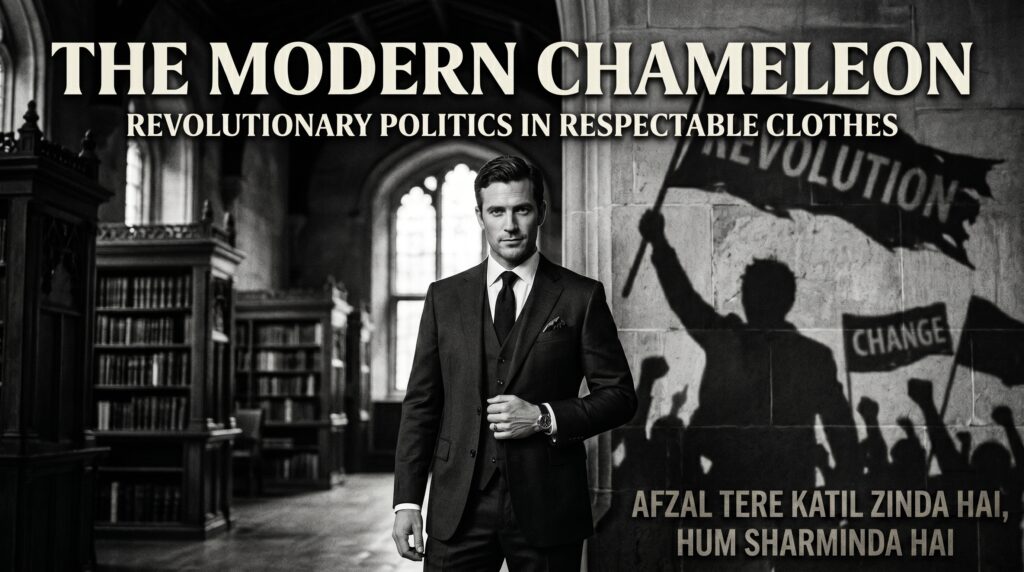
There is a classic magic trick where the magician asks you to watch his right hand while his left hand does all the work. Revolutionary politics in twenty-first-century India has perfected the same illusion. The right hand carries a petition about Adivasi land rights. The left hand, the one you are not watching, is building a supply chain for an armed movement that has killed thousands of civilians, security personnel, and its own informers over the past four decades. Understanding this trick, not to dismiss genuine grievances, but to see clearly who is performing them and why, is the most important political literacy skill an educated Indian can develop right now.
The Old Face Was Too Honest
The early Naxalite movement had no interest in disguise. Charu Majumdar’s Eight Documents, published between 1965 and 1967, called openly for the annihilation of class enemies and the seizure of state power through armed struggle. He wrote that a communist who had not “dipped his hands in the blood of class enemies” could not be called a communist. There was no euphemism, no civil society cover, no NGO letterhead. The language was exactly what it was.
The problem, from the movement’s perspective, was that this honesty was tactically catastrophic. It invited immediate state repression, alienated the urban middle class, and cut the movement off from the institutional networks, universities, courts, and media that could protect and sustain it. By the mid-1970s, the movement had been nearly destroyed. The lesson absorbed the old face, which had to go. A new face was needed. Educated, articulate, morally credentialed, and capable of operating in drawing rooms and newsrooms without triggering the alarm that a man with a gun automatically triggers.
The Manual They Wrote for Themselves
This strategic reorientation was not informal gossip. It was documented policy. After the reconstitution of the scattered Naxalite factions into the Communist Party of India (Maoist) in 2004, the party’s Central Committee produced a strategic document known as the Urban Perspective. It was cited in the Indian Parliament in a Ministry of Home Affairs response to Lok Sabha Unstarred Question No. 3838 in February 2014. It is not a conspiracy theory. It is the movement’s own published operational manual.
The document instructs the party to build three types of organisations in Indian cities: underground secret cells, semi-open recruitment networks, and, most relevantly, “open legal mass organisations that are not directly linked to the Party.” These front organisations are explicitly told to operate under publicly palatable cover programmes: workers’ rights, tribal rights, environmental protection, civil liberties, and women’s rights. They are told to “make use of such open forms of activity as are permitted by law, decree, and social custom”. ” The disguise is not an inference. It is a policy directive in the party’s own words.
Hoover’s Warning, Updated for India
J. Edgar Hoover described this exact mechanism in Masters of Deceit in 1958, drawing on three decades of FBI investigation into the American Communist Party. The party, he wrote, had built a sophisticated ecosystem of front organisations that presented publicly acceptable faces, peace committees, civil rights groups, and cultural associations while serving the party’s organisational and recruitment needs. The recruit who signed a petition against racial discrimination, who attended a rally for workers’ solidarity, and who joined a study circle on progressive history did not think of themselves as supporting a revolutionary movement. They considered themselves to be a good, morally engaged citizen. The movement depended on that self-perception. It cultivated it deliberately.
Substitute “UAPA petition” for “civil rights petition” and “Bastar” for “Mississippi”, and Hoover’s analysis translates exactly. The Indian Association of People’s Lawyers, which publicly describes itself as a civil liberties organisation, appears on the Ministry of Home Affairs list of active CPI (Maoist) front organisations. A petition signed by a Supreme Court lawyer and a Booker Prize-winning novelist carries a different public weight than one signed by party cadres. The movement understood this calculus and harvested it systematically.
The Four Languages of Disguise
The movement operates through four borrowed languages, each drawn from genuine and legitimate traditions of Indian public life. That borrowing is the camouflage’s central mechanism.
Rights language frames every security operation as state terror, every arrest under UAPA as a political imprisonment, and every counter-insurgency camp as a concentration camp. The language is real. The framing is a weapon in an information war.
Tribal and Adivasi language exploits genuine, documented grievances, displacement by mining, loss of forest rights, and administrative neglect as recruiting terrain. The Urban Perspective explicitly identifies tribal communities as a priority organisational target. Organisations that appear simultaneously on the Ministry of Home Affairs front organisation list and in the speeches of urban academics claiming to speak for tribal communities are performing exactly the function the manual prescribes.
Caste and Dalit language take real, morally indefensible discrimination and convert it from a constitutional problem to be resolved into a mobilisation resource to be maintained. The Urban Perspective instructs party units to mobilise Dalits and religious minorities “for the revolutionary movement”, not for constitutional remedies, not for institutional reform, but for the armed seizure of state power.
Anti-development and environmental language systematically opposes infrastructure in Maoist-affected areas, not because roads are bad, but because roads allow security force mobility into operational zones. The movement’s own document names anti-globalisation fronts as a priority organisational form for precisely this reason.
The Respectability Gradient
Here is the key insight that makes the entire system comprehensible: not everyone who uses these languages is organisationally connected to the movement. This is precisely what makes the system work.
Whittaker Chambers, writing in Witness, described how the American Communist Party consciously cultivated non-party liberals and progressives, not to convert them, but because their signatures on petitions and their appearances at rallies provided social cover the party could not generate internally. Arthur Koestler, in The God That Failed, put it more bluntly: ‘The party cared about these causes because they were useful. When they were no longer useful, the party discarded them.”
The result is what we can call a ‘respectability gradient’: a spectrum running from the fully committed inner-party member, through the front-organisation activist, through the sympathetic fellow traveller, all the way to the completely innocent person who simply agrees that tribals have been dispossessed and has no idea how that agreement is being used. Most people on this spectrum are not bad people. Many are acting from genuine moral concern. The system depends on exactly this fact.
Grievance Versus Exploitation
The clearest distinction in this entire analysis is between a genuine grievance and its political instrumentalisation. A genuine advocate for Adivasi land rights wants the dispute resolved, compensation paid, legal titles issued, and institutional representation secured. A resolved displacement dispute is useless to a revolutionary movement. An ongoing, festering, media-saturated displacement dispute is extremely valuable: it generates recruits, international advocacy, legal cover, and a narrative that frames the state as an oppressor.
The Urban Perspective is explicit on this point: the party is instructed to organise communities not for the resolution of their immediate grievances within the constitutional system, but for “preparation for the decisive struggle in the future”. The grievance is the entry point. The revolutionary programme is the destination. A person who cannot see the difference between these two things, or who refuses to look for it, is providing the camouflage whether they intend to or not.
How to See Through It
Legitimate dissent does not dissolve under direct questioning. An honest advocate for tribal rights can be asked, without deflection, whether they condemn Maoist killings of tribal informers, Maoist recruitment of children as combatants, and Maoist-imposed blockades on village markets, and they can answer those questions directly. Their advocacy for tribal rights does not depend on the Maoist programme, so separating the two costs them nothing.
The disguise fails this test. It fails it consistently, predictably, and in the same way every time: the pivot to “root causes”, the accusation that the questioner is attacking the grievance rather than the organisation exploiting it, and the description of every adverse court decision as proof of a fascist judiciary. The failure follows a script because the script is in the manual.
The chameleon changes its skin with every political season. The underlying animal does not change. Learning to see the animal through the skin is not cynicism. It is the minimum requirement for serious political engagement in India today.